

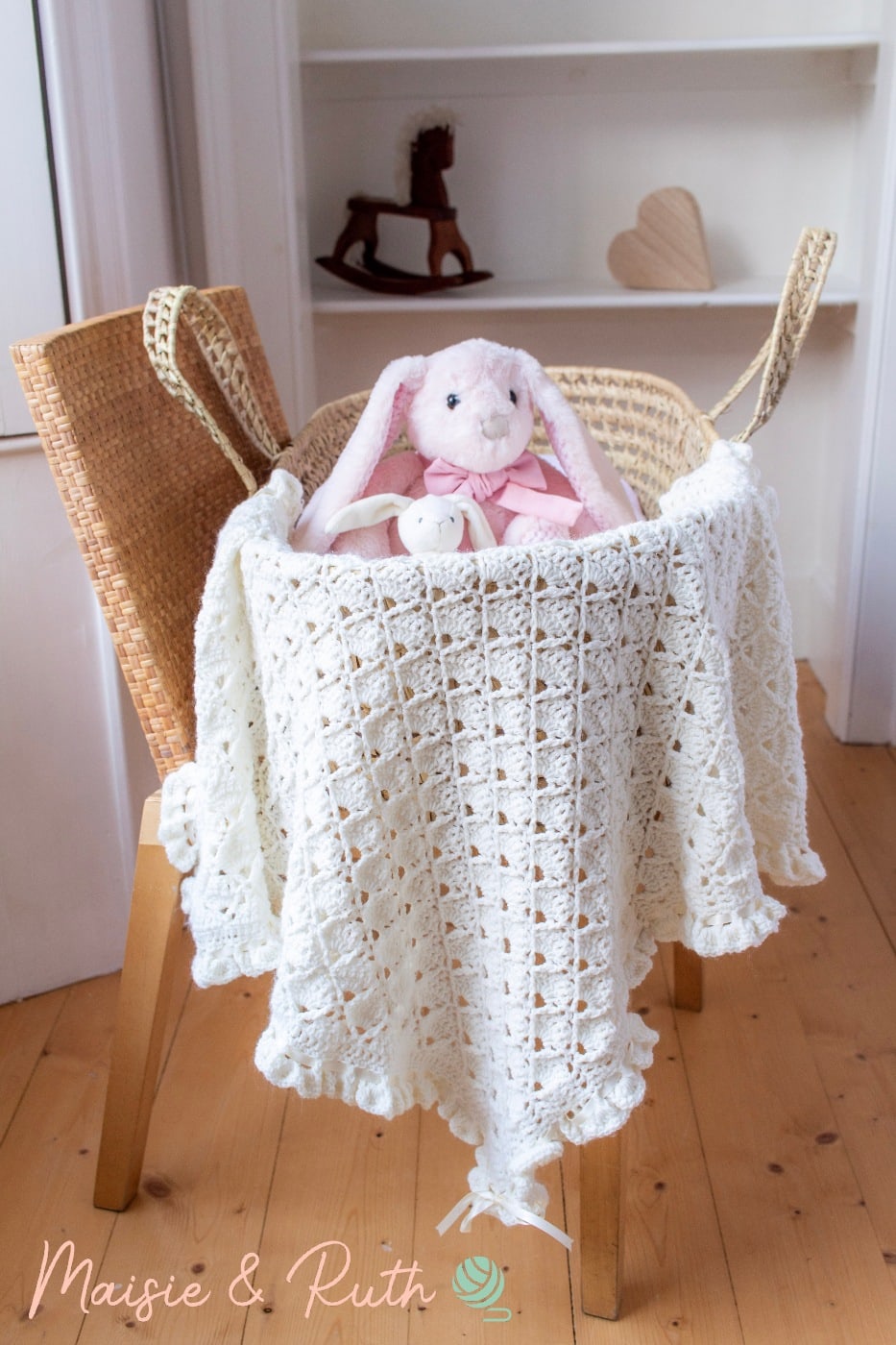
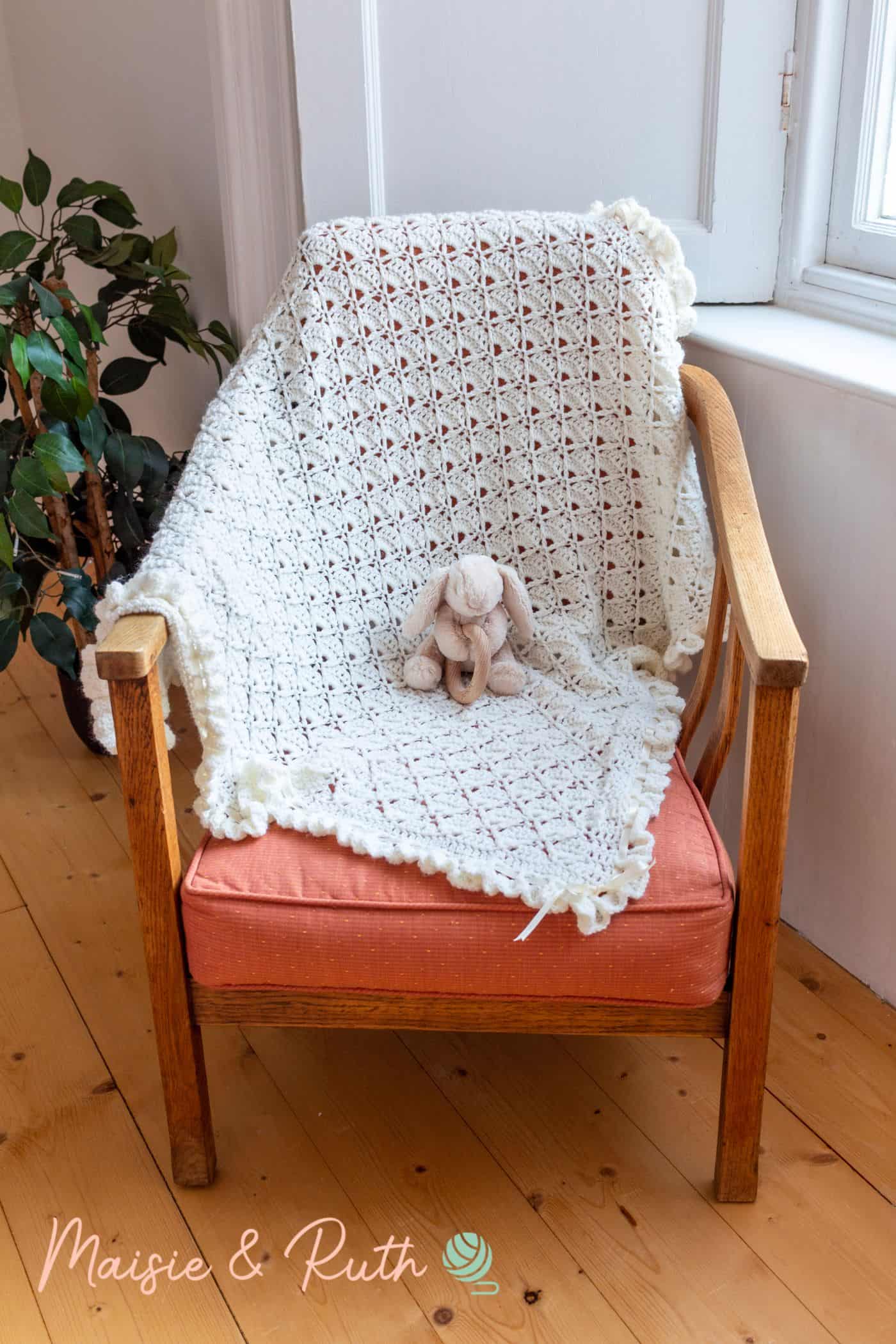
With its beautiful raised texture and delicate border, the Bonnie Blanket is a lovely project for a special little arrival. This free crochet baby blanket pattern combines the diamond trellis stitch with a soft, flowing fabric to create a blanket with a timeless, heirloom feel.
You’ll find the free pattern below, or you can purchase the ad-free, printable PDF if you prefer to keep a copy beside you as you crochet.
The textured stitches might look intricate but I’ll guide you through the pattern with step-by-step photos and a video tutorial. Once you become familiar with the four-row repeat, you’ll begin to see how the stitches come together to form this pretty design!
Why You’ll Love the Bonnie Blanket
- Beautiful texture: Raised stitches create an intricate-looking design using a combination of familiar stitches and front post double crochet.
- A satisfying repeat: Once you’ve learnt the four-row repeat, you can settle into the rhythm and enjoy watching your blanket grow.
- Help along the way: Step-by-step photos and a video tutorial guide you through the pattern.
- Easy to personalise: Choose a colour you love and adjust the dimensions to suit your project.
- A thoughtful handmade gift: The delicate texture and coordinating border give this blanket a timeless finish, perfect for a special little arrival.
A Blanket to Treasure
I chose the name “Bonnie,” a Scots word meaning pretty, because it felt just right for this delicate design.
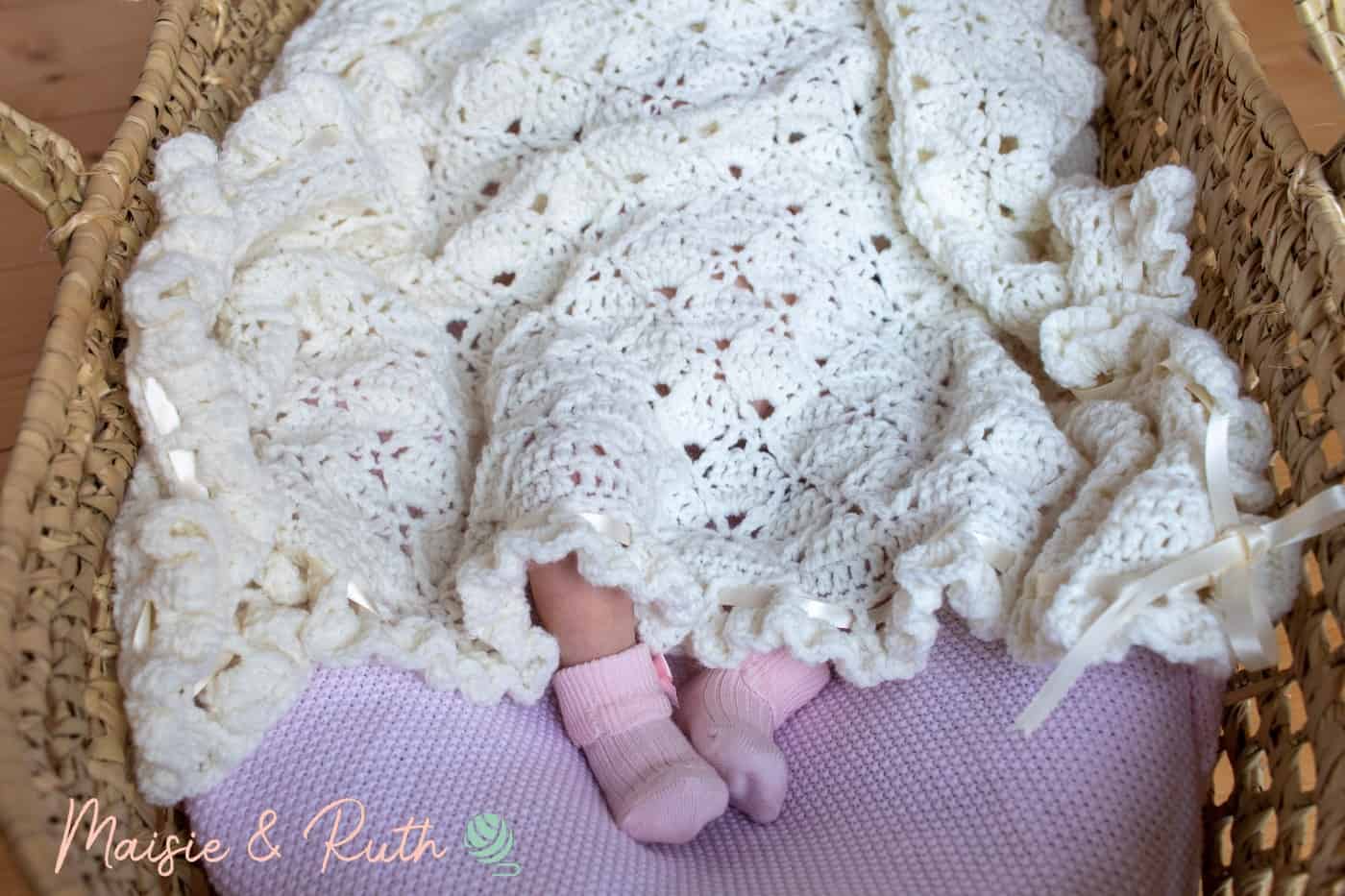
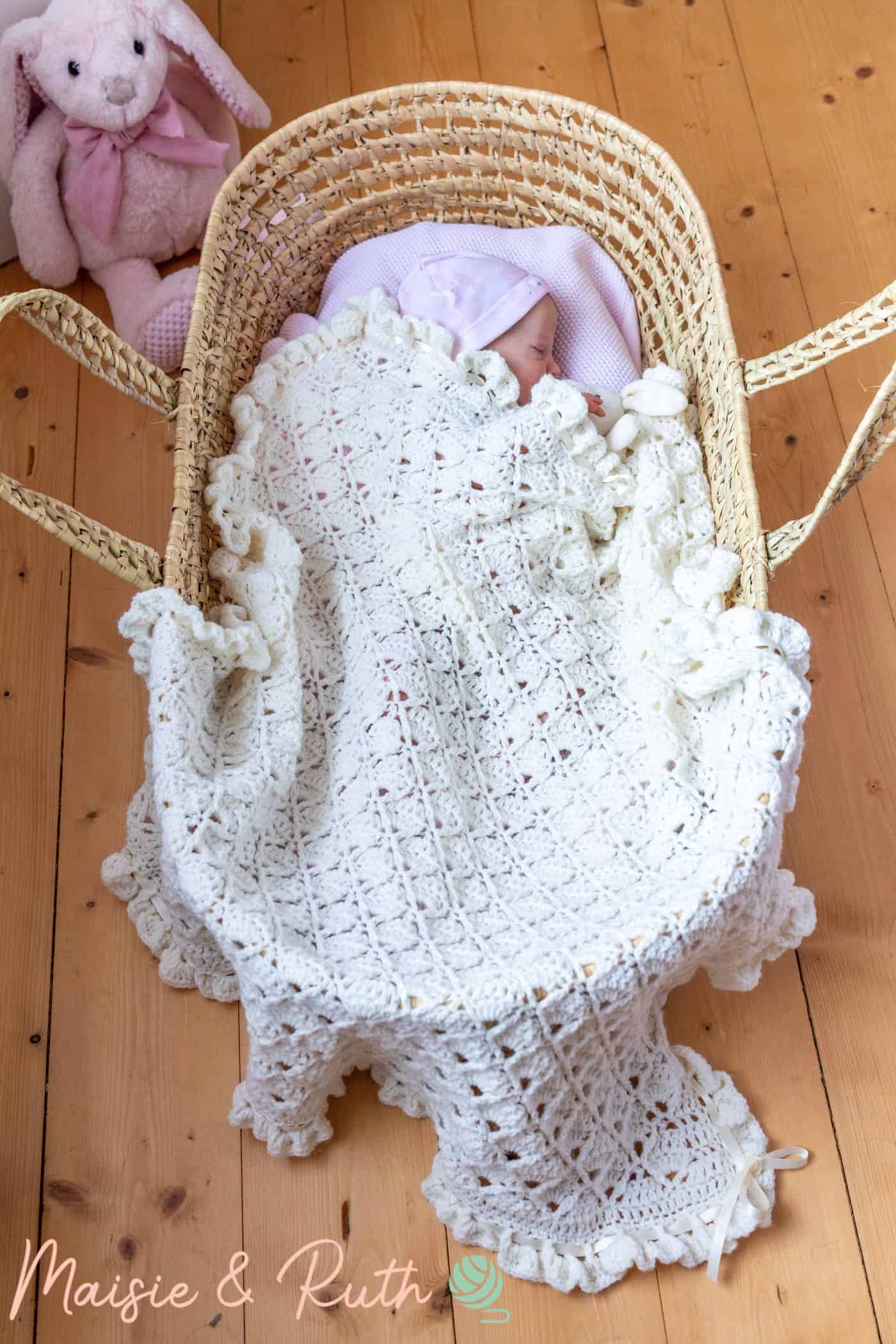
Worked in a soft off-white shade, the Bonnie Blanket has a traditional look that would make a thoughtful baby shower or new baby gift. It’s also a lovely choice if you’re hoping to crochet a special keepsake for a christening or naming day.
One of my favourite things about this blanket is how much detail you can create with just one colour. The raised stitches give the fabric depth and texture, allowing the stitch pattern itself to take centre stage.
Of course, you can choose any colour you love! A soft pastel would give the blanket a gentle, classic look, while a richer shade would bring a different feel to the same design.
The Diamond Trellis Stitch
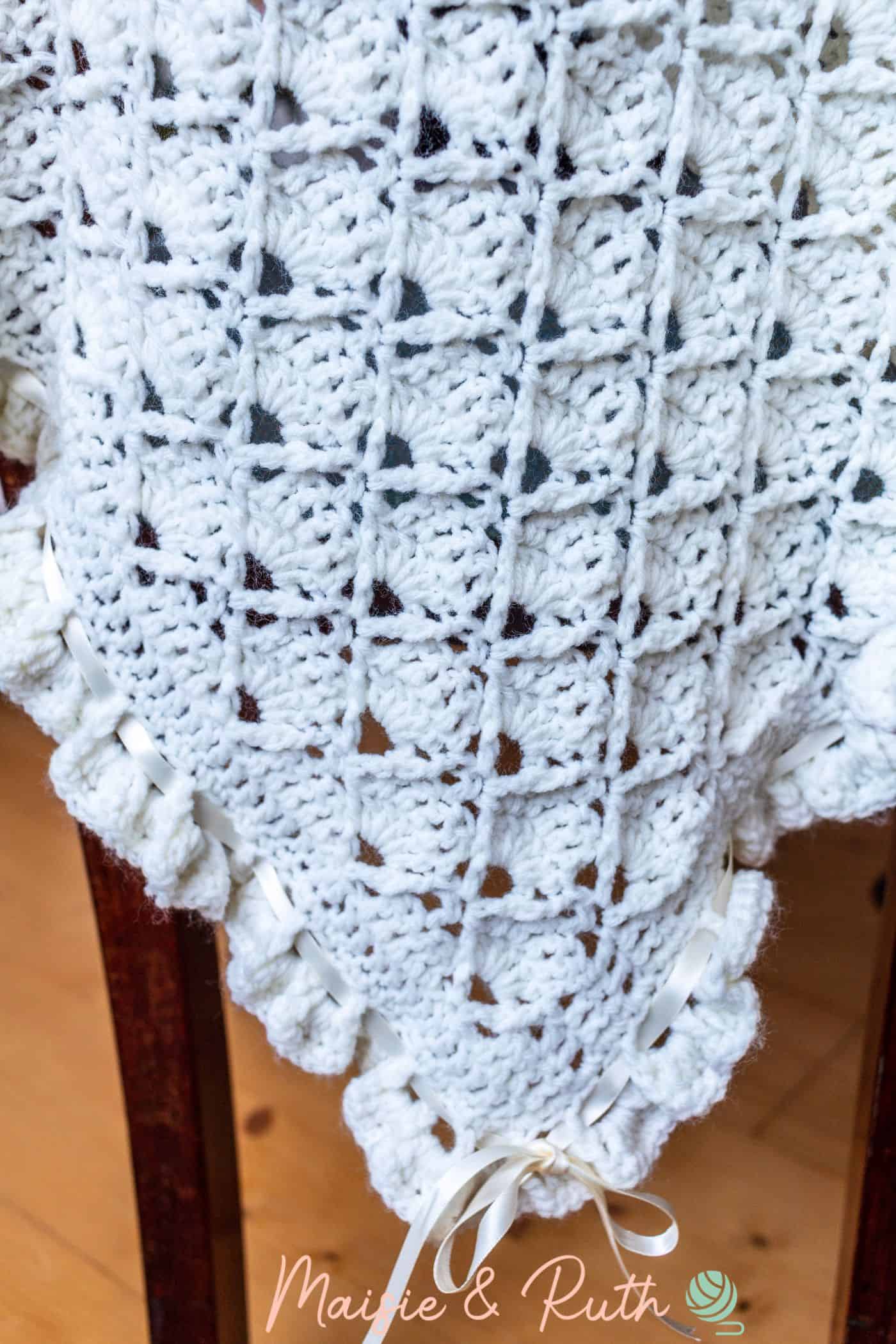
The Bonnie Blanket uses the crochet diamond trellis stitch, which combines double crochet, front post double crochet, V-stitches and shells.
The front post stitches are worked around the posts of stitches rather than into the tops. This brings parts of the design forward, creating the raised texture that makes the blanket so distinctive.
After the opening rows, the main body follows a four-row repeat. There are a few different steps to learn but the repeating sequence makes it easier to recognise where your next stitches belong as the blanket grows.
If you would like to try the stitch before beginning the blanket, take a look at my Crochet Diamond Trellis Stitch photo tutorial. The gauge swatch included in this pattern is also a useful way to practise.
Is the Bonnie Blanket Suitable for Beginners?
This pattern is rated intermediate because of the stitch placement and the combination of stitches used throughout the design.
However, if you’re comfortable with basic crochet stitches and ready to learn something new, you may enjoy giving it a try with the help of the photos and video.
I recommend making the small practice swatch first. It gives you a chance to learn the repeat, practise your front post stitches and check your tension before starting the full width of the blanket.
Take your time with the first few rows and don’t worry if you need to refer back to the instructions frequently at first!
Yarn Used for the Bonnie Blanket
For my original blanket, I used Paintbox Yarns Baby DK in Champagne White (1702), a subtle off-white shade that complements the traditional style of the design.
This acrylic and nylon blend gives the blanket a soft feel, while the smooth yarn helps the raised stitches show clearly.
The original pattern calls for:
- Seven 50g balls of Paintbox Yarns Baby DK.
- Each ball contains approximately 183 yards / 167 metres.
- A 4.5mm crochet hook.
The slightly larger hook helps create a fabric with a lovely drape. When making your own blanket, use the gauge swatch to check both the measurements and the feel of your fabric.
Choosing a Substitute Yarn
If you’re using a different yarn, look for a smooth DK / light category #3 yarn that allows the stitch detail to show.
A solid colour is a lovely choice for this pattern, as it keeps the focus on the diamond trellis texture. Very fluffy or strongly variegated yarns may make the individual stitches harder to see.
When choosing a substitute, compare the yarn’s length per ball as well as its weight. Two DK yarns can come in the same size ball but contain quite different amounts of yarn, so you may need a different number of balls.
Make a swatch with your chosen yarn before starting and check the care instructions on the yarn label. Changing the yarn or hook can affect the finished size, drape and amount of yarn required.
Finished Blanket Size
The Bonnie Blanket measures approximately:
- Before blocking: 26 × 28 inches / 66 × 71cm.
- After blocking: 28 × 30 inches / 71 × 76cm.
Blocking helps neaten the edges and open out the stitch pattern for a more polished finish.
Use a blocking method appropriate for your yarn’s fibre content. If you’re new to this step, my How to Block Crochet tutorial explains the different methods.
How to Adjust the Size
You can adapt the Bonnie Blanket by changing the number of starting chains and the number of row repeats.
For the foundation chain, work a multiple of 8, then add 7 chains. This is the same as the stitch multiple of 8 + 5, with 2 additional chains for the foundation chain.
For example, the original blanket begins with 119 chains:
112 + 5 + 2 = 119 chains.
To change the width, add or remove chains in groups of eight. To change the length, work more or fewer complete four-row repeats, finishing on a Row 7 repeat before following the instructions for the final row.
Remember to allow for the border when planning your finished measurements. A larger blanket will also require more yarn.
For help planning another size, see my Crochet Baby Blanket Size Chart and How to Resize a Crochet Blanket Pattern posts.
A Pretty Finishing Border
The Bonnie Blanket is finished with a four-round border that echoes the stitches used in the main body.
Shells and front post stitches carry the texture out to the edges, giving the blanket a coordinated finish without needing to introduce a completely different stitch pattern.
I love how the border frames the diamond trellis design—it’s the final detail that brings the blanket together!

More Crochet Baby Patterns
If you’re putting together a handmade gift for a new arrival, there are lots more free crochet baby patterns to explore here at Maisie and Ruth!
The Gracie Baby Booties would make a sweet little gift alongside your Bonnie Blanket, while Bella the Bunny is a lovely project if you’d like to crochet a cuddly companion.
If you enjoy making blankets, take a look at the Barclay Blanket and Paisley Baby Blanket too. Each has its own distinctive texture and includes step-by-step photos to help you along the way.
You’ll also find crochet baby hats, cardigans and other little makes on the blog—perfect for using your favourite yarns to create something special.

Purchase the Ad-Free Printable PDF
Prefer to crochet from a printed pattern or keep a copy on your tablet?
The Bonnie Blanket is also available as an ad-free, printable PDF from my Etsy and Fourthwall shops. It contains the same pattern information as the free version here on the blog, in a convenient format that you can save and refer to as you work.
Thank you so much for supporting my patterns and helping me continue sharing crochet projects here at Maisie and Ruth!

Ad-Free Download
PDF PRINTABLE PATTERN
- Easy-to-read (no ads!)
- Print-friendly & tablet-friendly
- Yours to keep and use forever
Thank you for supporting my shop!
Ready to begin? Gather your yarn and hook and read through the materials, gauge information and pattern notes below.
Enjoy my free crochet patterns?
Add Maisie & Ruth as a Preferred Source on Google to help you find more of my patterns in Google Search
The Bonnie Blanket: A Free Crochet Baby Blanket Pattern
Before you begin, please carefully read all the information below… I’ve included useful points that will aid you in making this blanket.
Level
Intermediate (see details of project levels at the Craft Yarn Council).
Materials
- Yarn: #3, light worsted / DK / 8 ply. I used 7 balls of Paintbox Yarns Baby DK in the colour Champagne White (1702), 183 yds/ 1.8oz (167m / 50g)
- Crochet Hook: Size 7 (4.5mm)
- Scissors
- Yarn needle
- Ribbon (optional): 5.5yds (5 metres) of ribbon size 5/8″ (14mm)
Gauge / Tension
I made a small swatch which measures 6.25 inches wide by 5 inches long. In addition to measuring your gauge / tension, working up this swatch will allow you to practise the pattern before working up the full blanket:
Ch 31 (your foundation chain should be fairly tight)
Row 1 (RS). 1dc in 4th ch from hook (skipped 3 chs count as 1st dc), 1dc in each ch until end of row, TURN [29 sts].
Row 2 (WS). Ch2 (counts as a dc here and throughout), 1dc in next 4 sts, *sk 1 st, (1dc, ch3, 1dc) in the next st, sk 1 st, 1dc in next 5 sts*, repeat from * to * across to the end of the row, TURN, [26 sts (3 V sts visible].
Row 3. Ch2, 1dc in next 2 sts, *sk 2 sts, FPdc in next st, 5dc in ch3 sp, FPdc in next st, sk 2 sts, 1dc in next st*, repeat from * to * across the row to last 2 sts, 1dc in last 2 sts, TURN, [29 sts (3 shells visible)].
Row 4. Ch2, 1dc in next 2 sts, sk 1 st, 1dc in next 5 sts, *sk 1 st, (1dc, ch3, 1dc) in next st, sk 1 st, 1dc in next 5 sts*, repeat from * to * across the row to last 4 sts, sk 1 st, 1 dc in last 3 sts, TURN, [25 sts (2 V sts visible)].
Row 5. Ch2, 1dc in next 2sts, sk 2 sts, 1dc in next st, *sk 2 sts, FPdc in next st, 5dc in ch3 sp, FPdc in next st, sk 2 sts, 1dc in next st*, repeat from * to * across the row to last 5 sts, sk 2sts, 1dc in last 3 sts, TURN, [23 sts (2 shells visible)].
Row 6. Ch2, 1dc in next 2 sts, (1dc, ch3, 1dc) in next st, *sk 1 st, 1dc in next 5 sts, sk 1 st, (1dc, ch3, 1dc) in next st*, repeat from * to * across the row to last 3 sts, 1dc in last 3 sts, TURN, [22 sts (3 V sts visible)].
Row 7. Ch2, 1dc in next 2 sts, FPdc in next st, 5dc in ch3 sp, FPdc in next st, *sk 2 sts, 1dc in next st, sk 2 sts, FPdc in next st, 5dc in ch3 sp, FPdc in next st*, repeat from * to * across the row to last 3 sts, 1dc in last 3 sts ,TURN, [29 sts (3 shells visible)].
Repeat rows 4-7 once more.
Finished Size
Before blocking:
Width – 26 inches
Length – 28 inches
After blocking:
W -28 inches
L – 30 inches
For tips on blocking, please read my post How to Block Crochet (3 Easy methods). In this article, I describe the benefits of blocking and how you can block all fibres, including items made from acrylic yarn.
Stitches & Abbreviations (US Crochet Terms)
(If you crochet using UK terms, the Craft Yarn Council have a useful page detailing the crochet term differences between the US, UK and Canada).
beg – beginning
ch(s) – chain(s)
dc – double crochet: Yarn over (yo), insert hook into stitch, yo, pull up a loop, 3 loops remaining on hook. Yo, pull through 2 loops, 2 loops remaining on hook. Yo, pull through remaining 2 loops. 1 double crochet completed.
fasten off – To fasten off securely, work one chain, then cut the yarn leaving a 5 – 6” tail. Pull the tail through the loop that is on your hook. Tighten gently.
RS – right side: The side of your work that you want to have on display – the ‘pretty’ side.
sc – single crochet: Insert hook into stitch, yarn over (yo), pull up a loop, 2 loops remaining on hook. Yo, pull through both loops on hook. 1 single crochet completed.
sk – skip: Do not crochet into these stitches.
sl st – slip stitch: Insert hook into stitch, yarn over (yo), pull up a loop, 2 loops on hook. Pull the first loop through the second loop. 1 slip stitch completed.
sp – space
st(s) – stitch(es)
WS – wrong side: The back of your crochet piece.
* to * – Repeat instructions between asterisks as many times as directed.
( ) – Sets of stitches to be worked within one stitch or space.
[ ] – The total number of stitches at the end of a row.
Special Stitches
FPdc – front post double crochet: Yarn over (yo), insert hook from front to back to front around the post of the next stitch, yo, pull up a loop, 3 loops remaining on hook. Yo, pull up a loop and pull through 2 loops on hook, 2 loops remaining on hook. Yo, pull up a loop and pull through remaining 2 loops on hook. 1 FPdc completed.
V stitch – (1dc, ch3, 1dc) worked in the same stitch
Shell – 5dc in ch3 space
Pattern Notes
- US crochet terms used throughout.
- 4-row pattern repeat (repeat rows 4 – 7).
- You can easily adjust the size of this blanket: the pattern uses a multiple of 8 + 5 (add an extra 2 for the foundation chain). For this particular pattern I chained 119 in total (I chained 112, which is divisible by 8, then 5 extra chains were made. A further 2 chains were added for the foundation chain).
- The ch2 made at the beginning of each row counts as the first dc of the row.
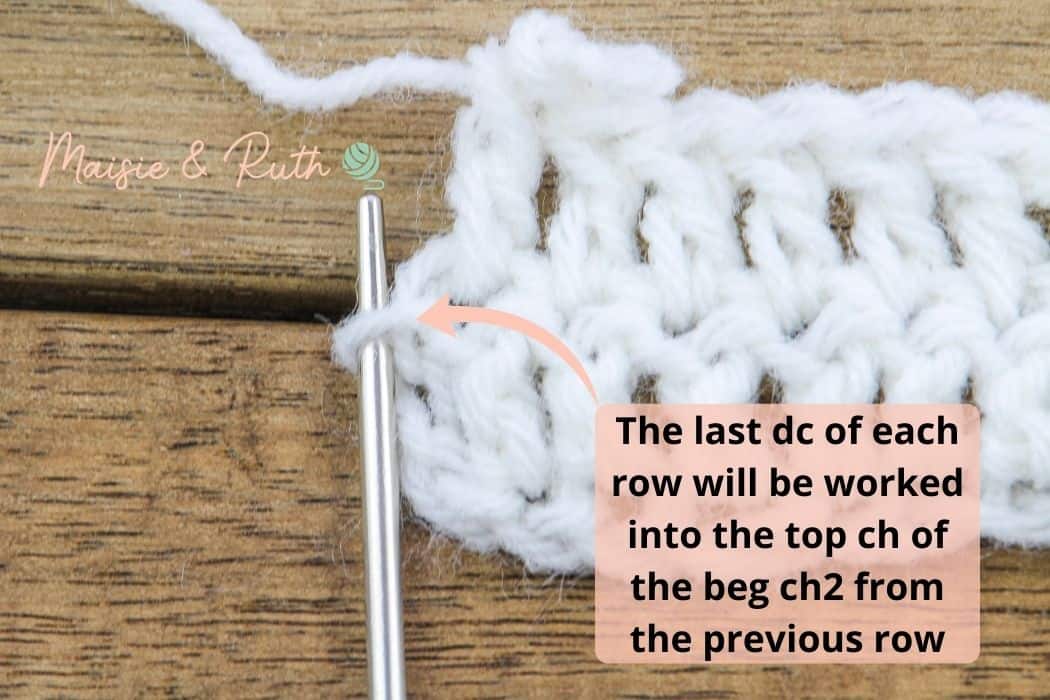
- At the end of rows, your last stitch should be worked into the top of the ch2 from the previous row.
- I have provided full written instructions at the beginning of each row. I then break down these instructions and provide photos of the required steps / stitches for greater clarification.
Pattern Instructions
Chain 119 (make sure that your foundation chain is fairly tight)
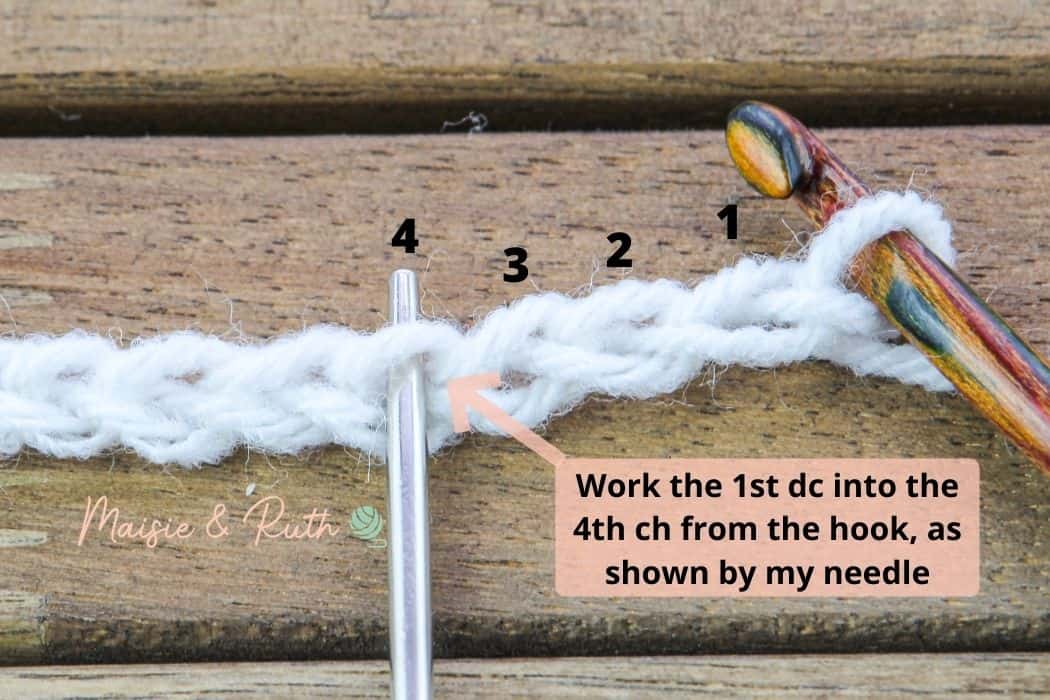
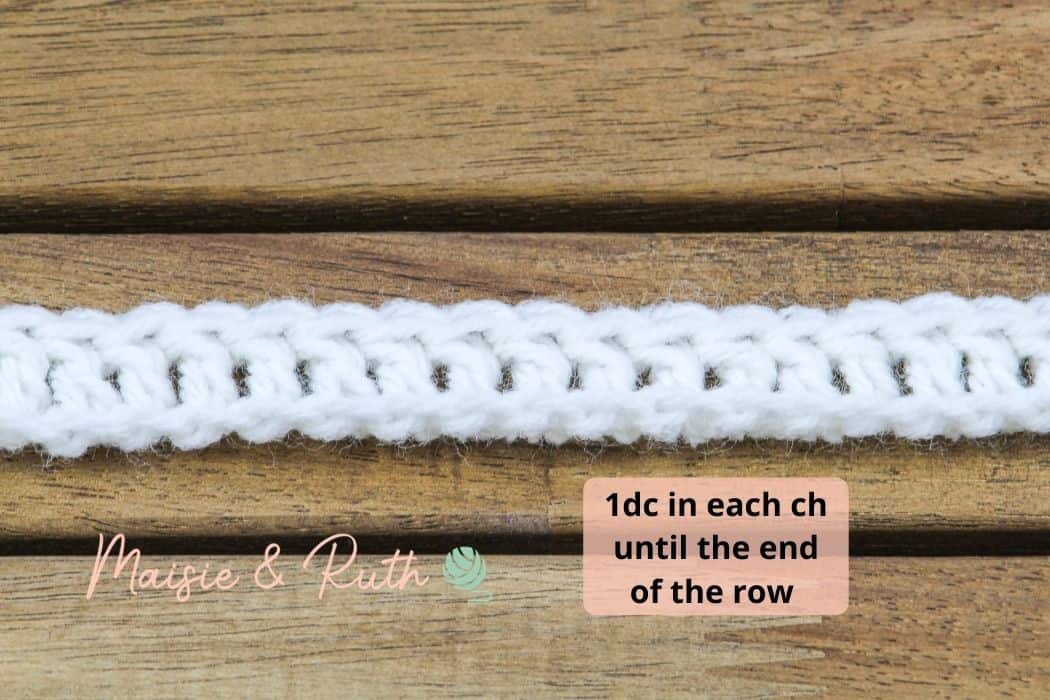
Row 1. 1dc in the 4th ch from hook (skipped 3 chs count as 1st dc), 1dc in each ch until end of row, TURN, [117 sts].
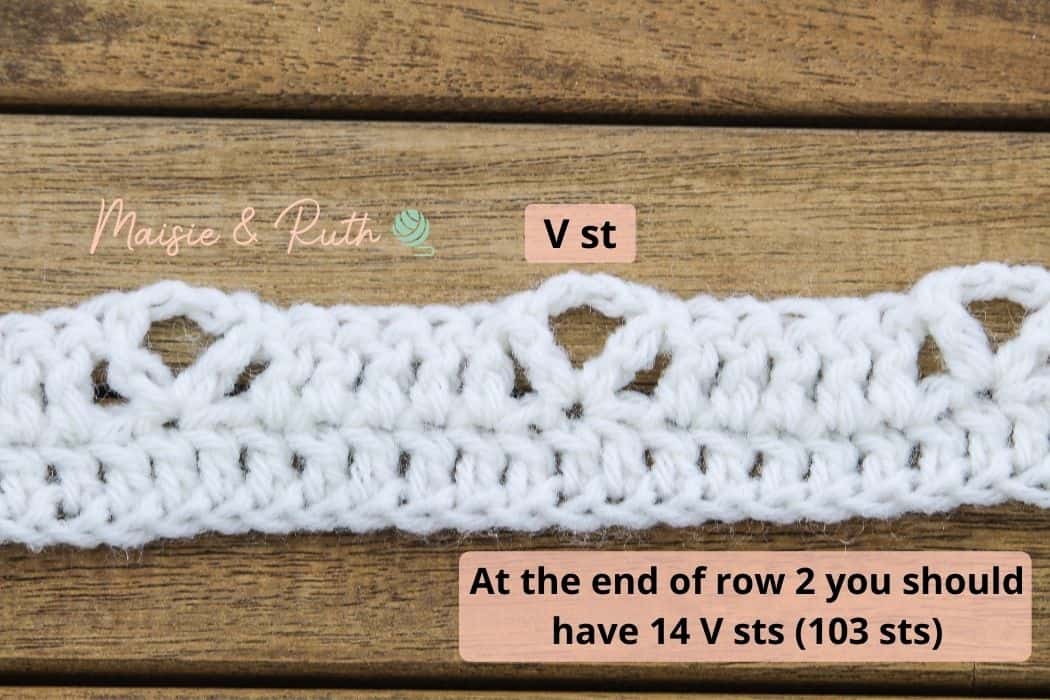
Row 2. Ch2 (counts as a dc here and throughout), 1dc in next 4 sts, *sk 1 st, (1dc, ch3, 1dc) in the next st, sk 1 st, 1dc in next 5 sts*, repeat from * to * across the row, TURN, [103 sts total (14 V sts visible)].
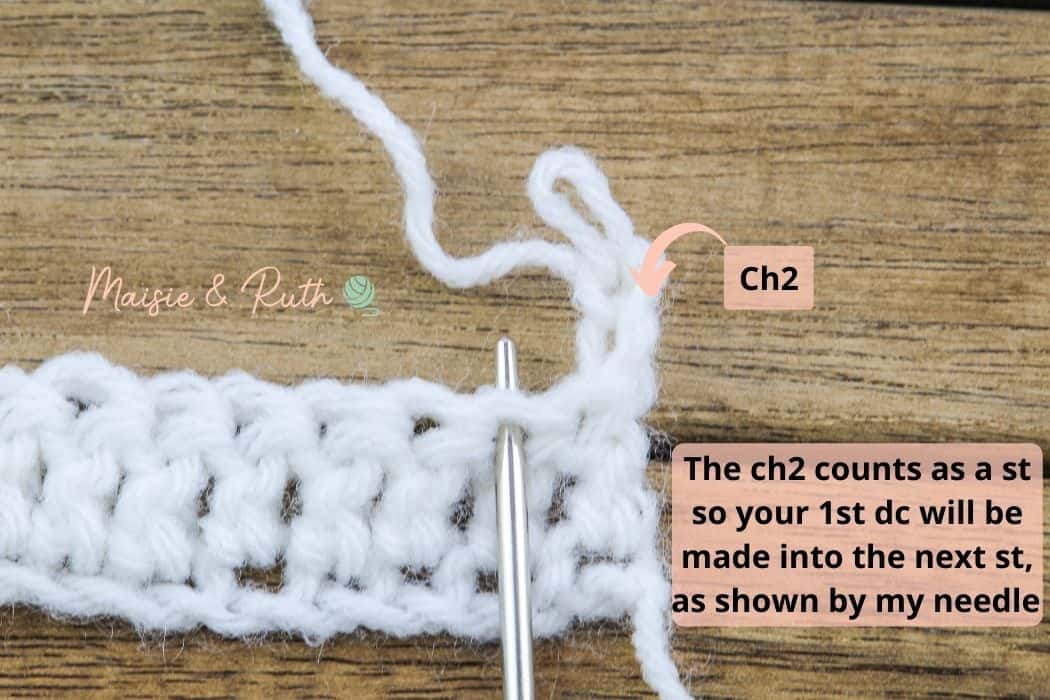
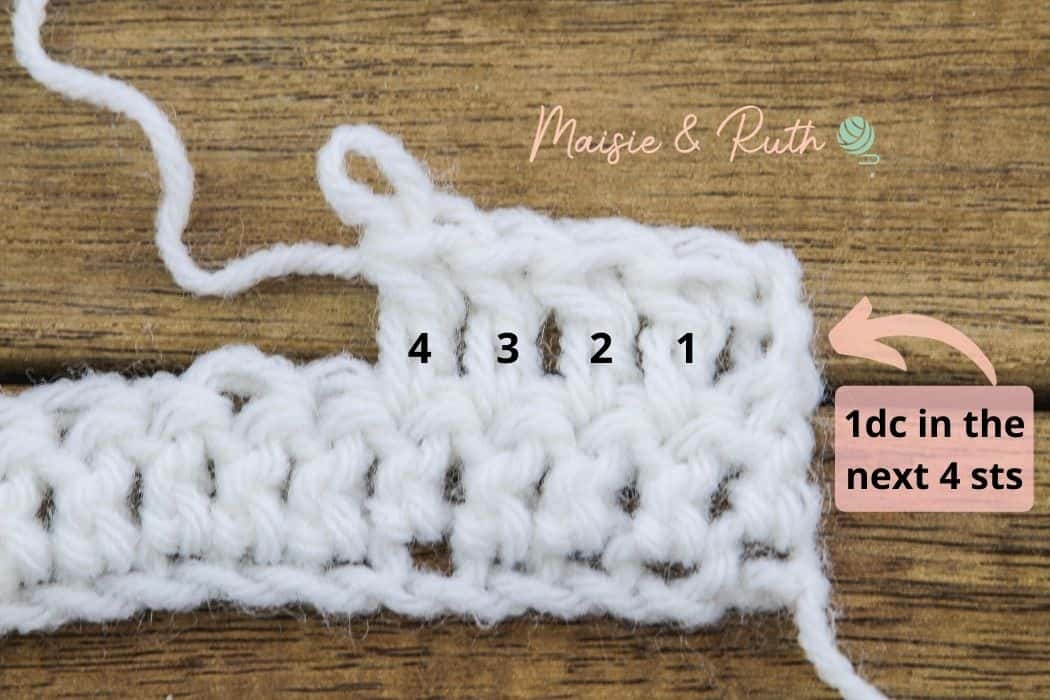
The following stitches that you will now work will form the row repeat (the instructions between * to *):
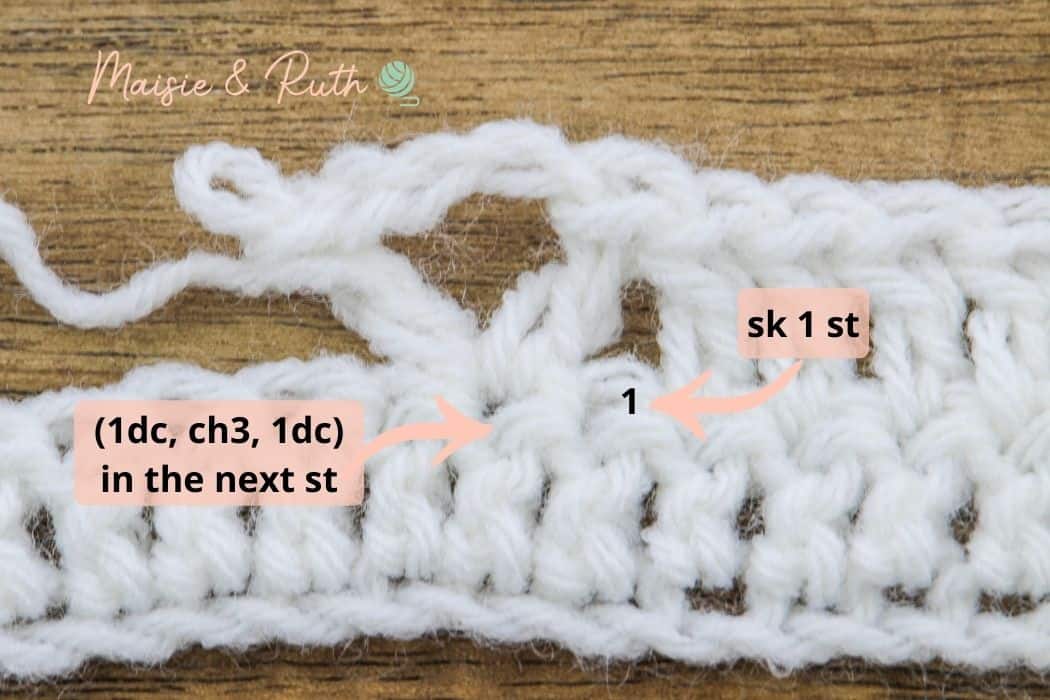
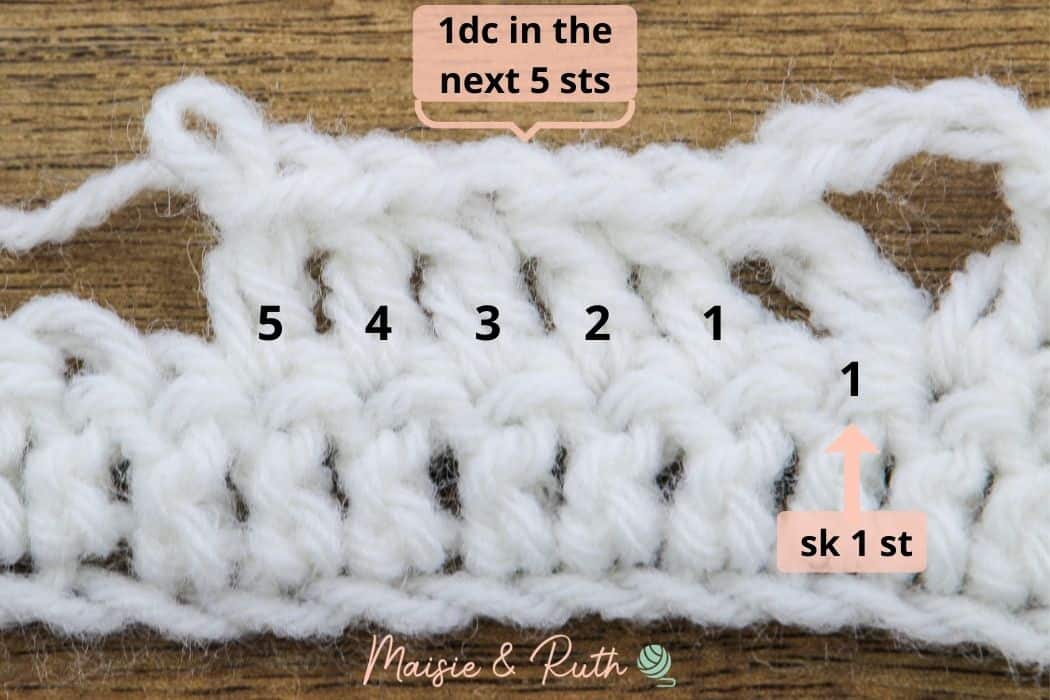
Work the row repeat across to the very end of the row.
Once you get to the end of each row, it’s important not to forget to work into the top of the beginning ch2 from the previous row… it’s very easy to miss this last stitch! (see image below).
Row 3. Ch2, 1dc in next 2 sts, *sk 2 sts, FPdc in next st, 5dc in ch3 sp, FPdc in next st, sk 2 sts, 1dc in next st*, repeat from * to * across the row to last 2 sts, 1dc in last 2 sts, TURN [117 sts total (14 shells visible)].
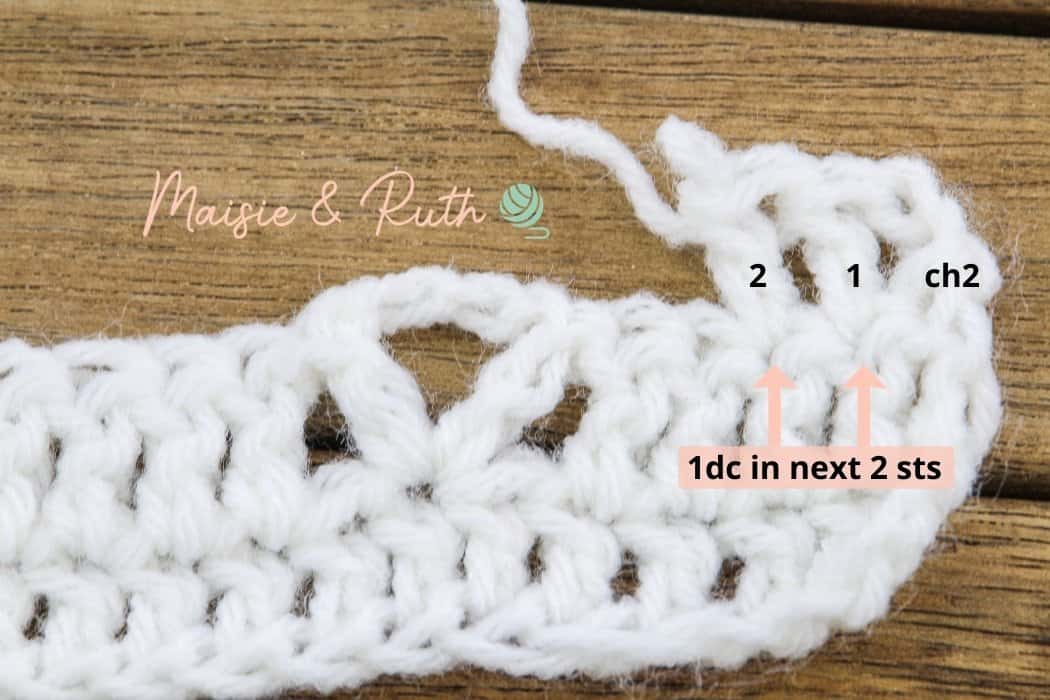
The following stitches that you will now work will form the row repeat:
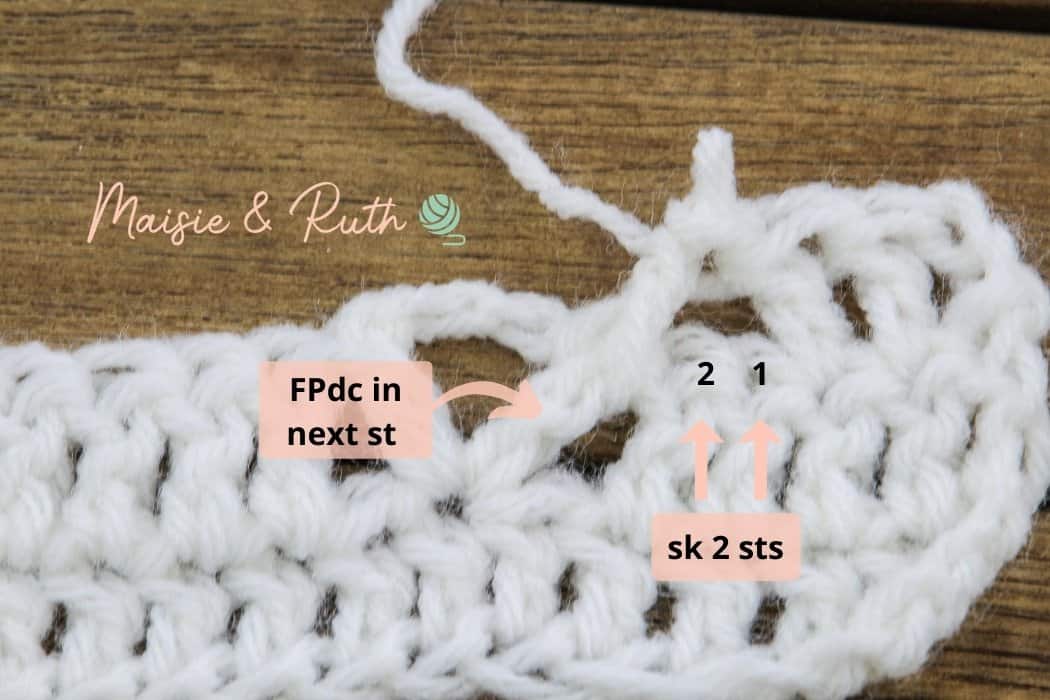
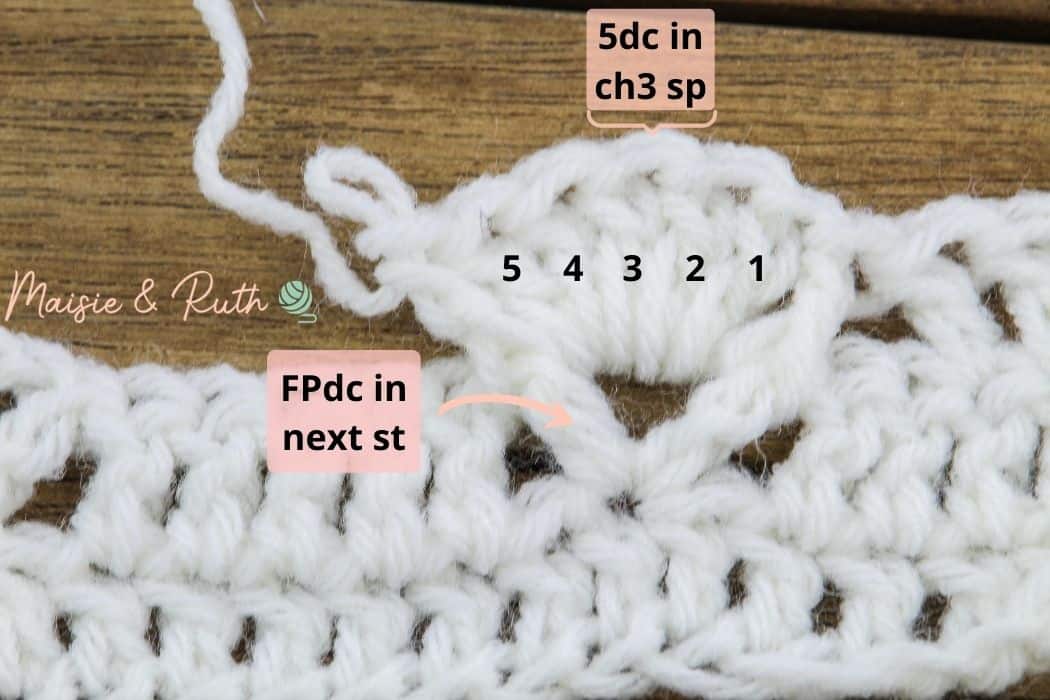
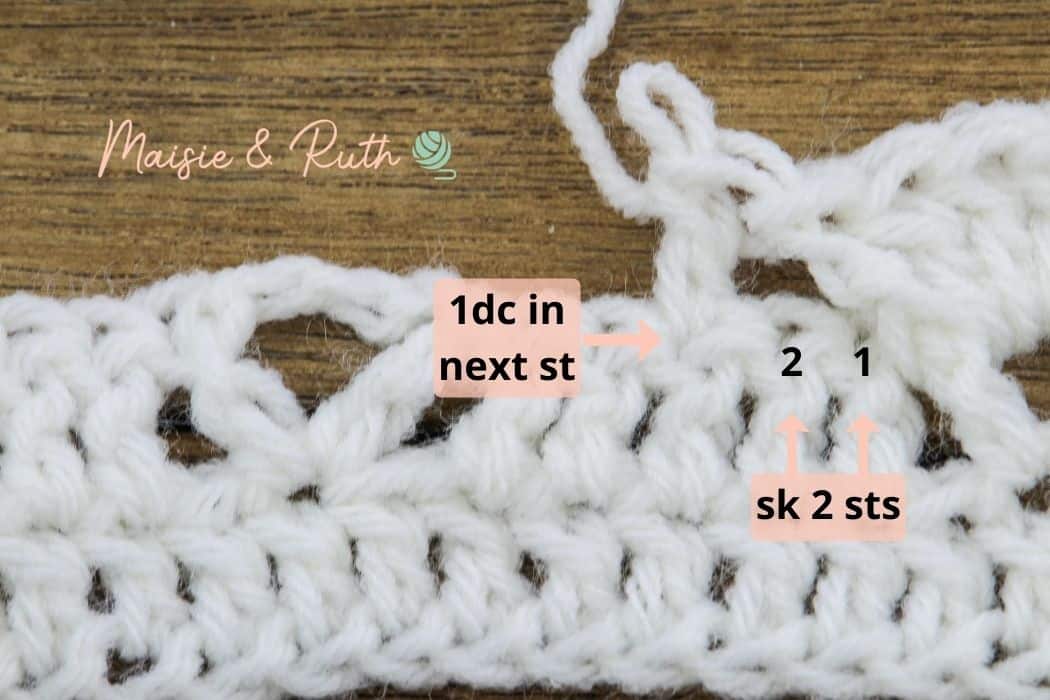
Work the row repeat across the row to the last 2 sts.
Work the last 2 stitches as follows:
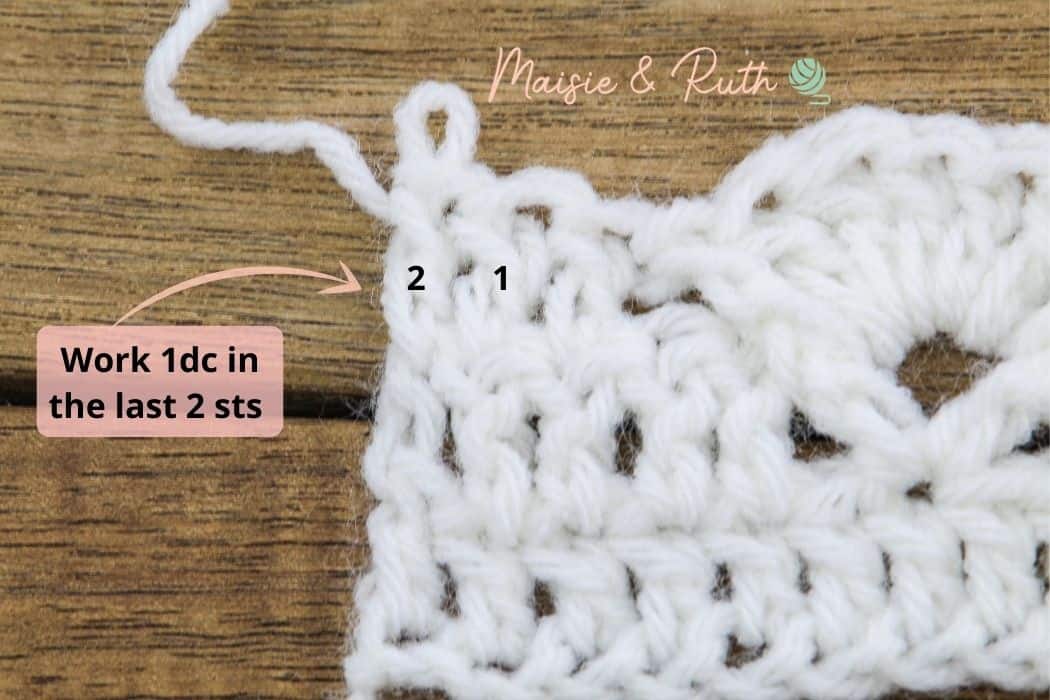
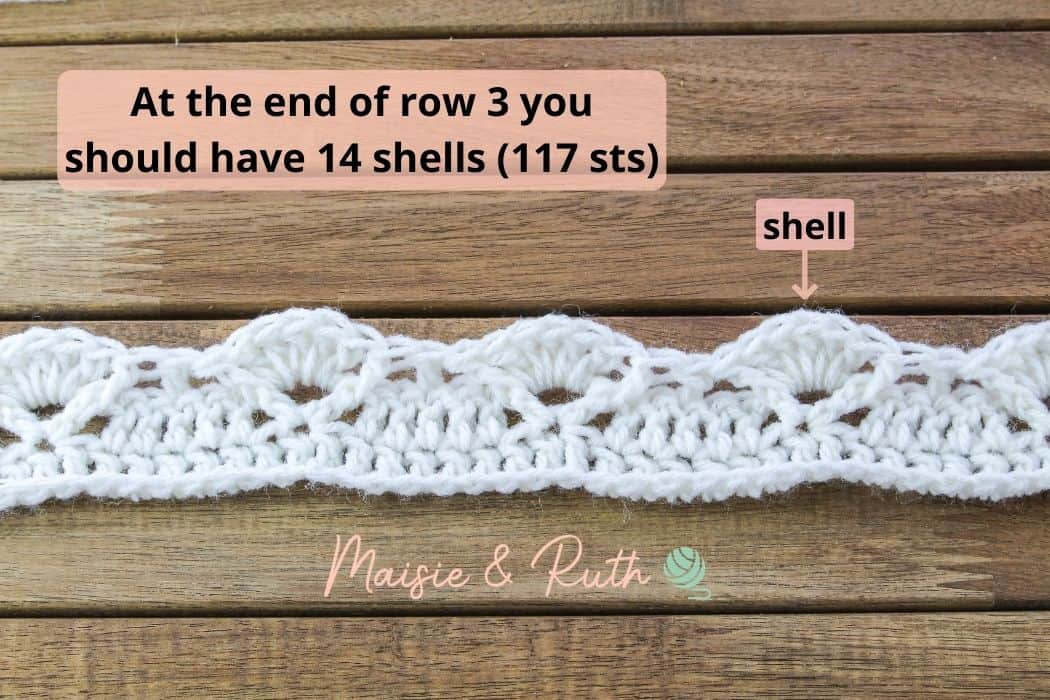
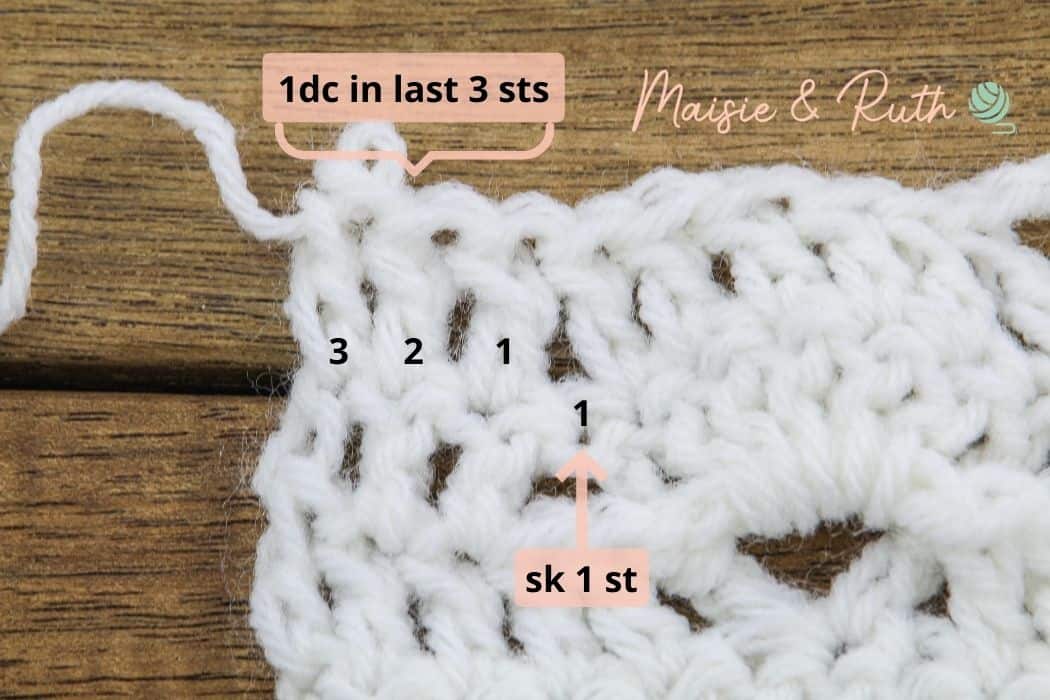
Row 4. Ch2, 1dc in next 2 sts, sk 1 st, 1dc in next 5 sts, *sk 1 st, (1dc, ch3, 1dc) in next st, sk 1 st, 1dc in next 5 sts*, repeat from * to * across the row to last 4 sts, sk 1 st, 1 dc in last 3 sts, TURN, [102 sts total (13 V sts visible)].
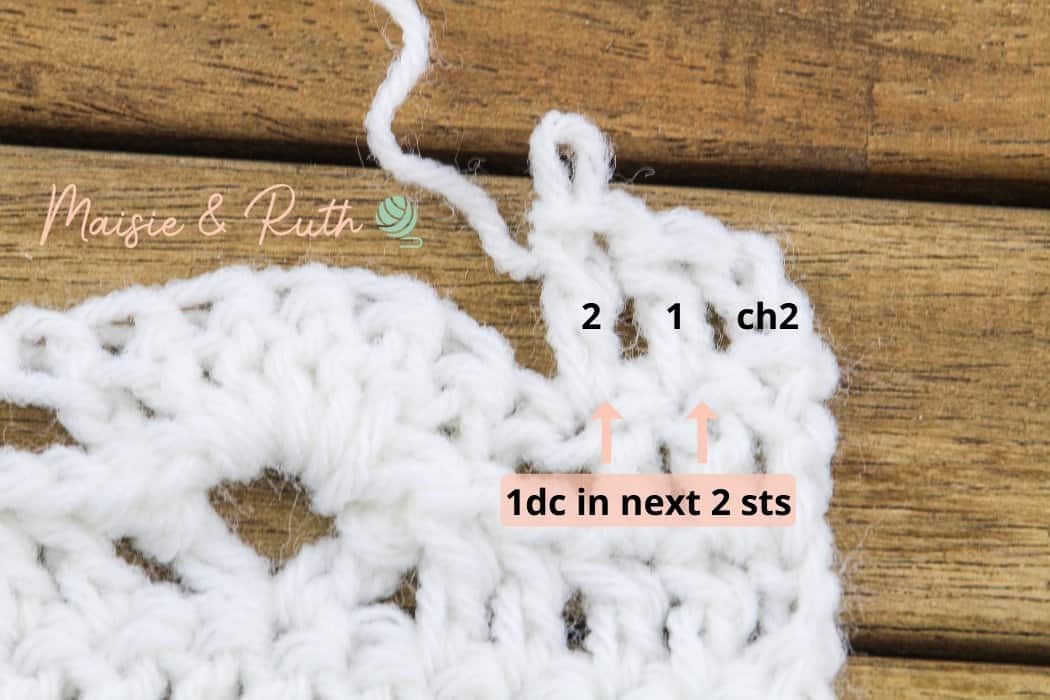
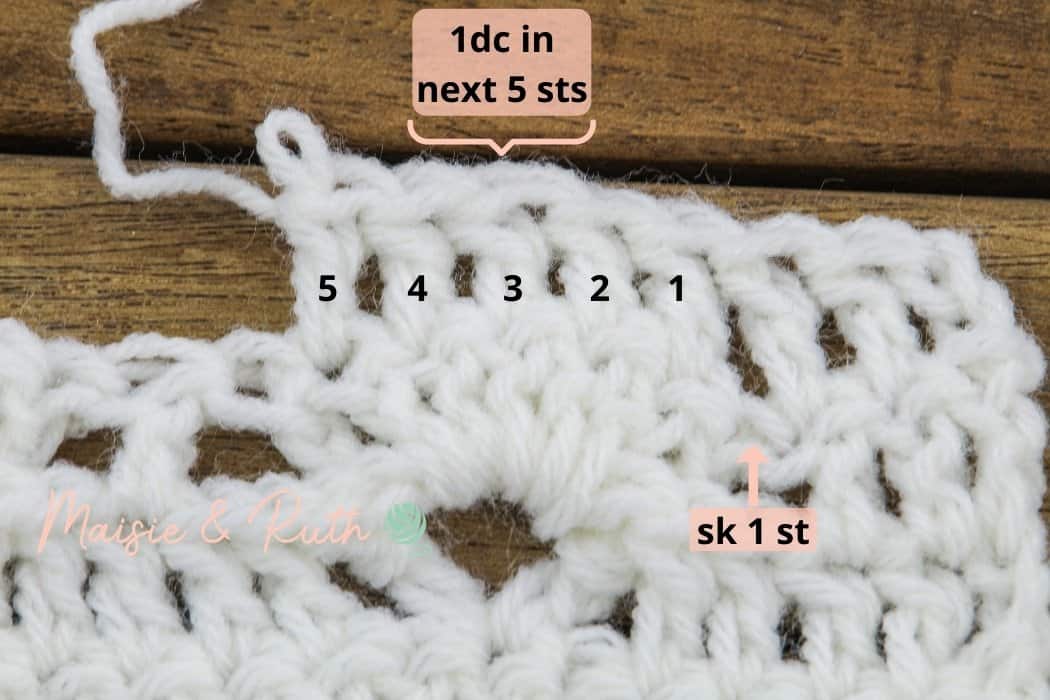
The following stitches that you will now work will form the row repeat:
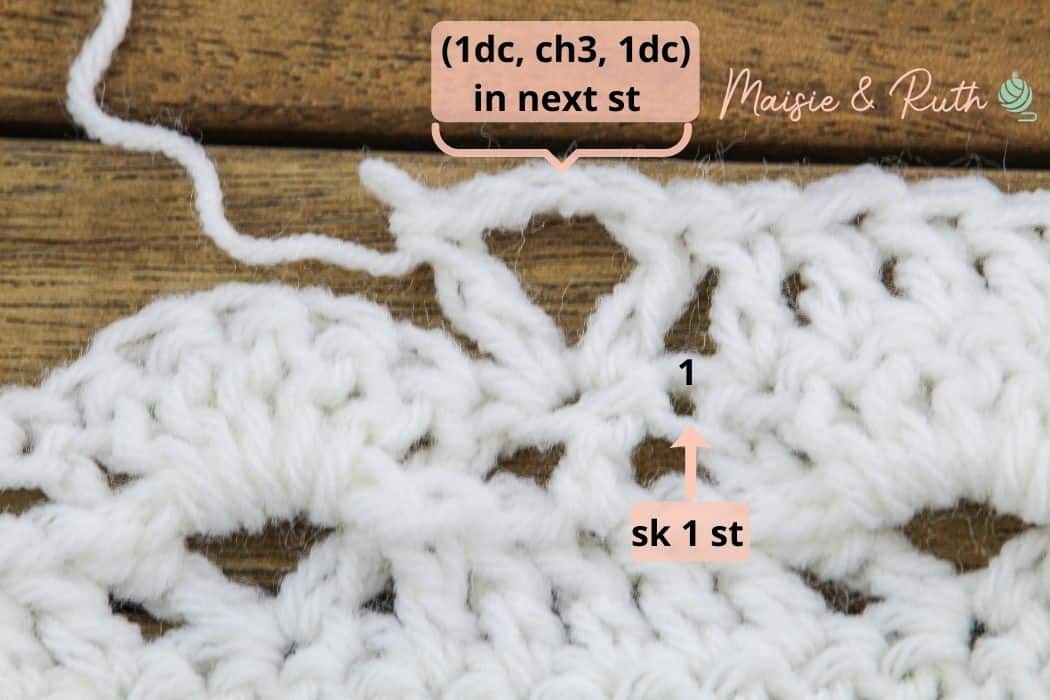
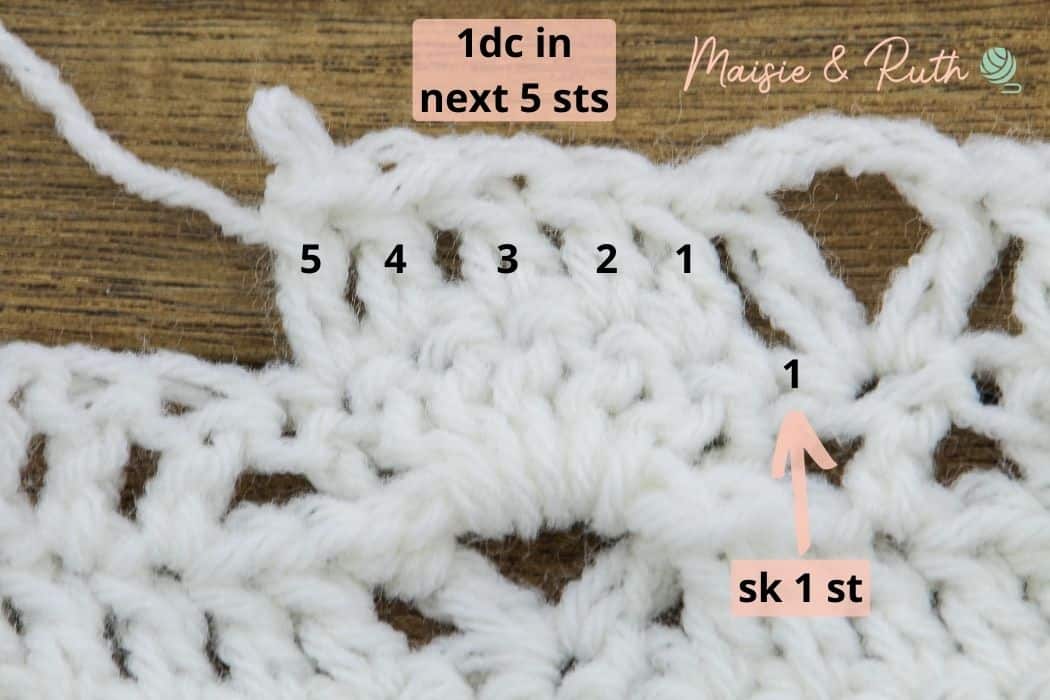
Work the row repeat across the row to the last 4 sts.
Work the last 4 stitches as follows:
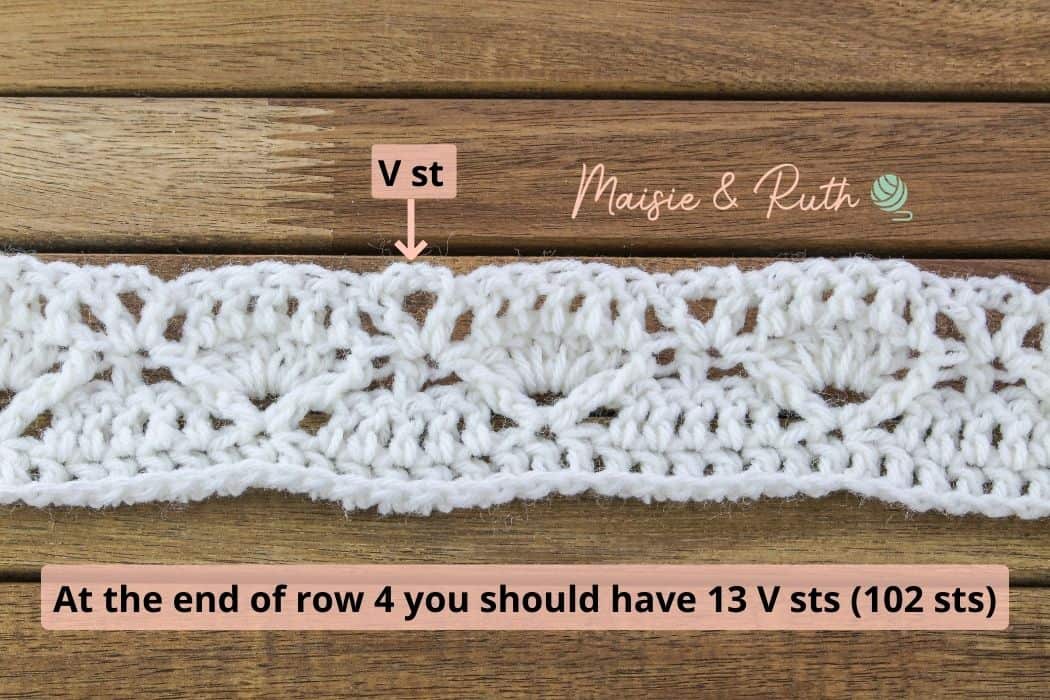
Row 5. Ch2, 1dc in next 2sts, sk 2 sts, 1dc in next st, *sk 2 sts, FPdc in next st, 5dc in ch3 sp, FPdc in next st, sk 2 sts, 1dc in next st*, repeat from * to * across the row to last 5 sts, sk 2sts, 1dc in last 3 sts, TURN, [112 sts total (13 shells visible)].
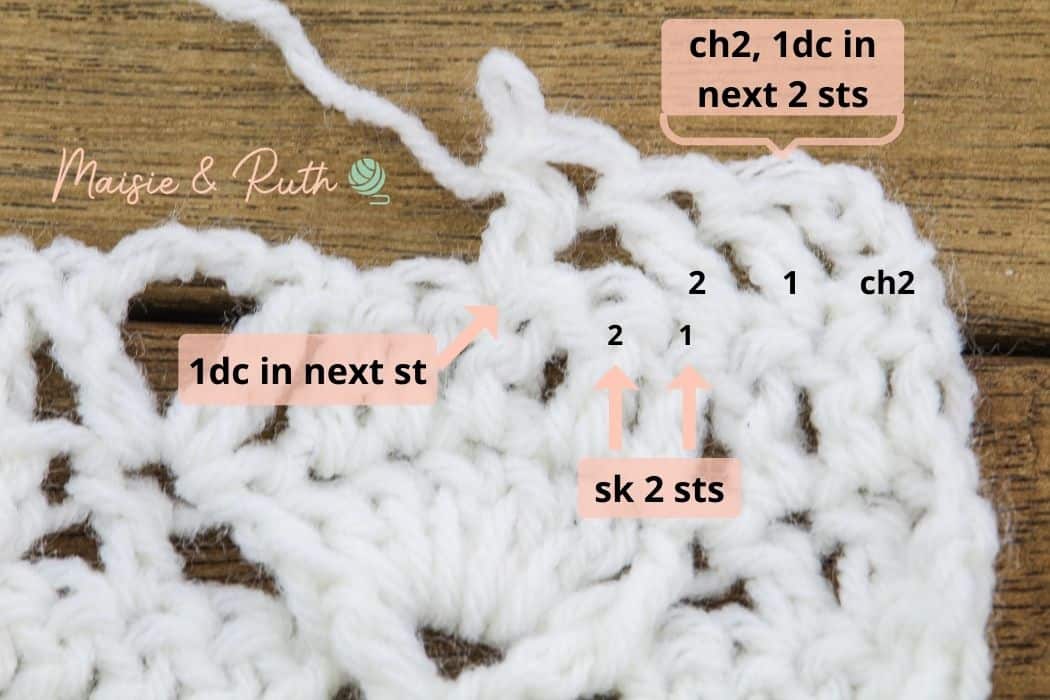
The following stitches that you will now work will form the row repeat.
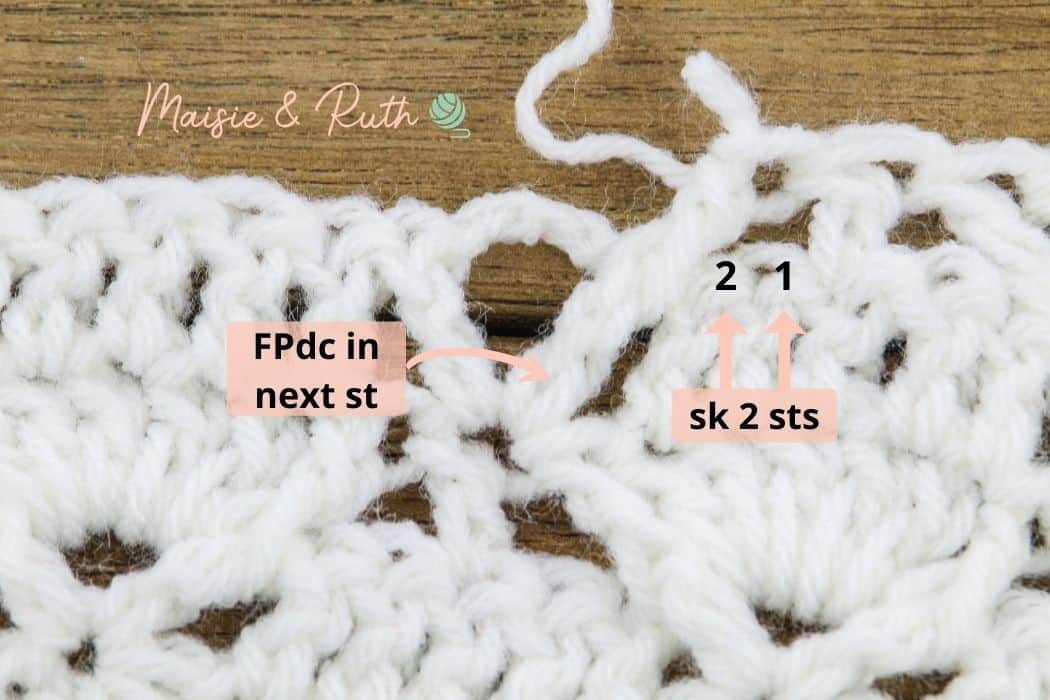
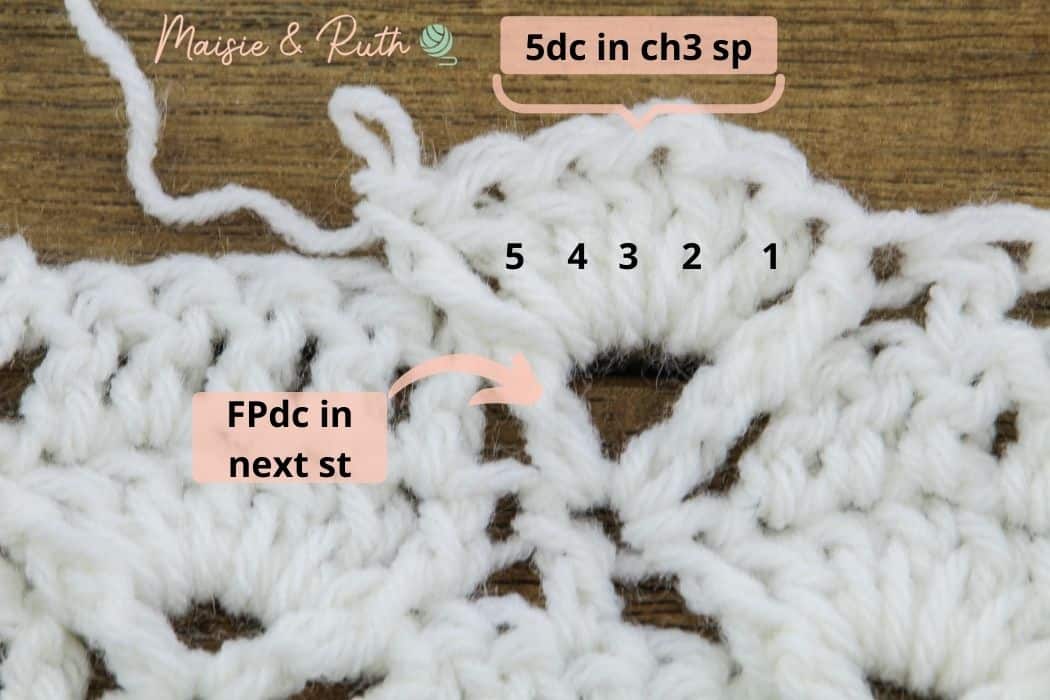
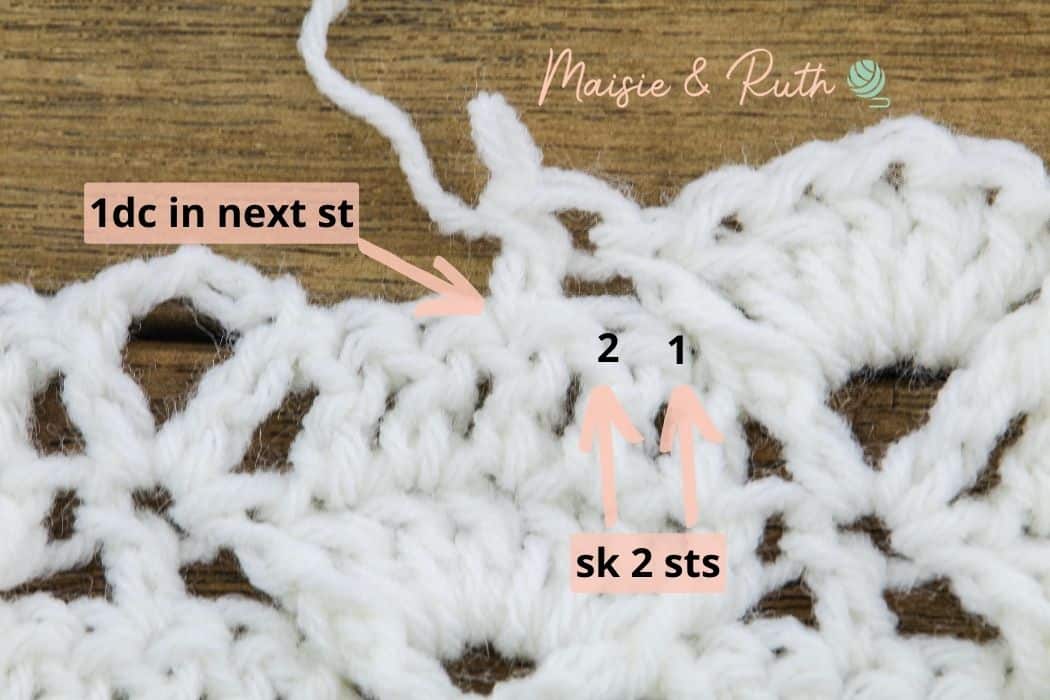
Work the row repeat across the row to the last 5 sts.
Work the last 5 stitches as follows:
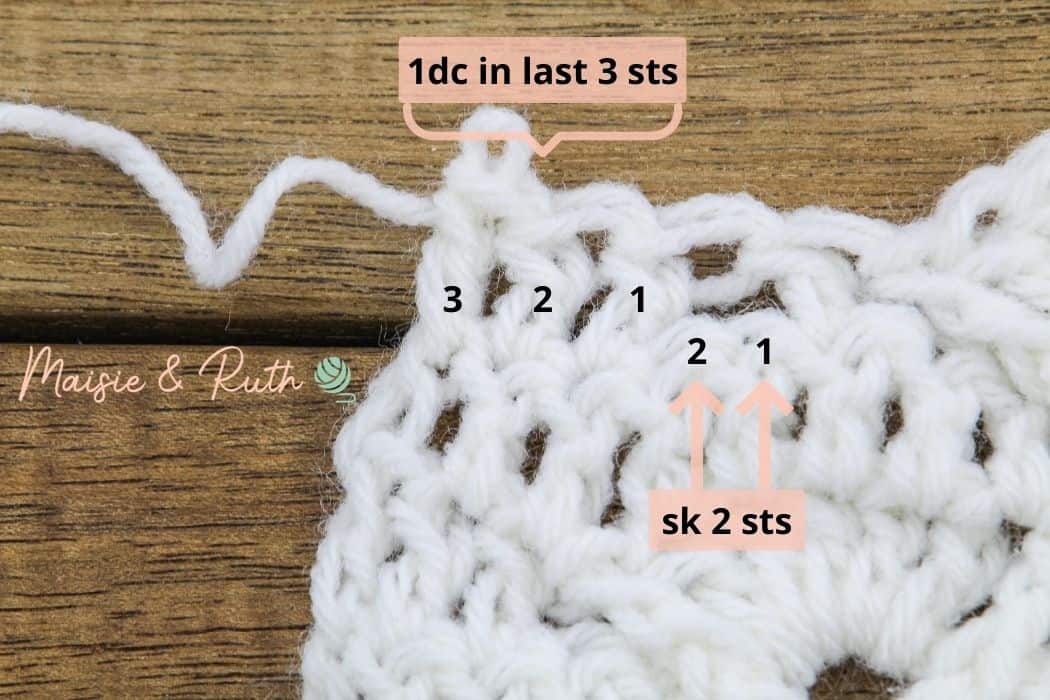
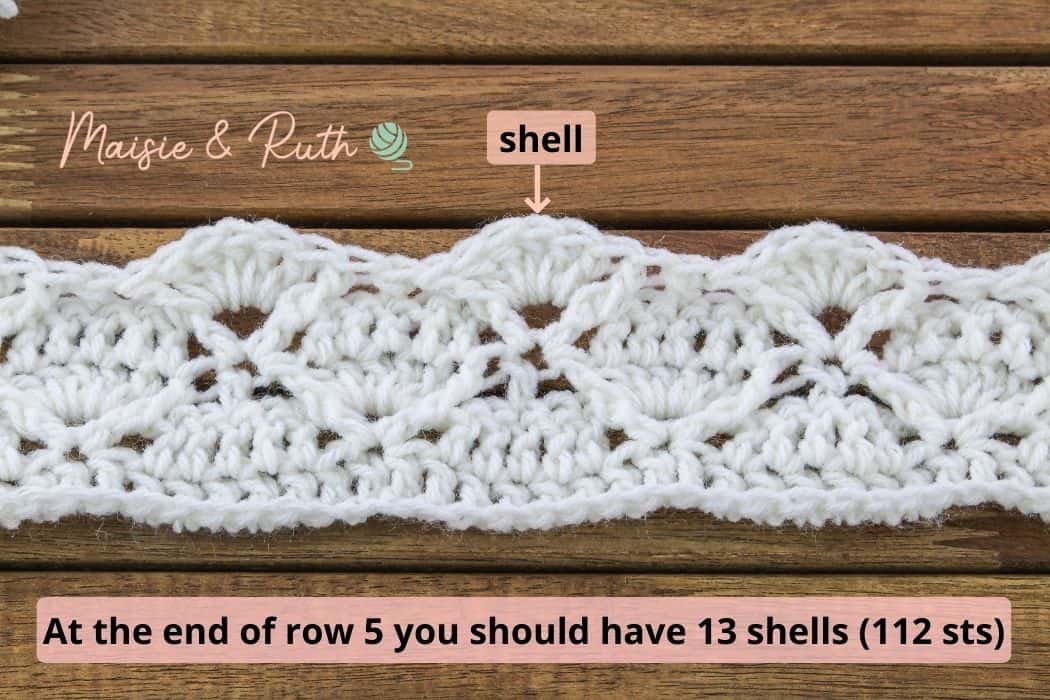
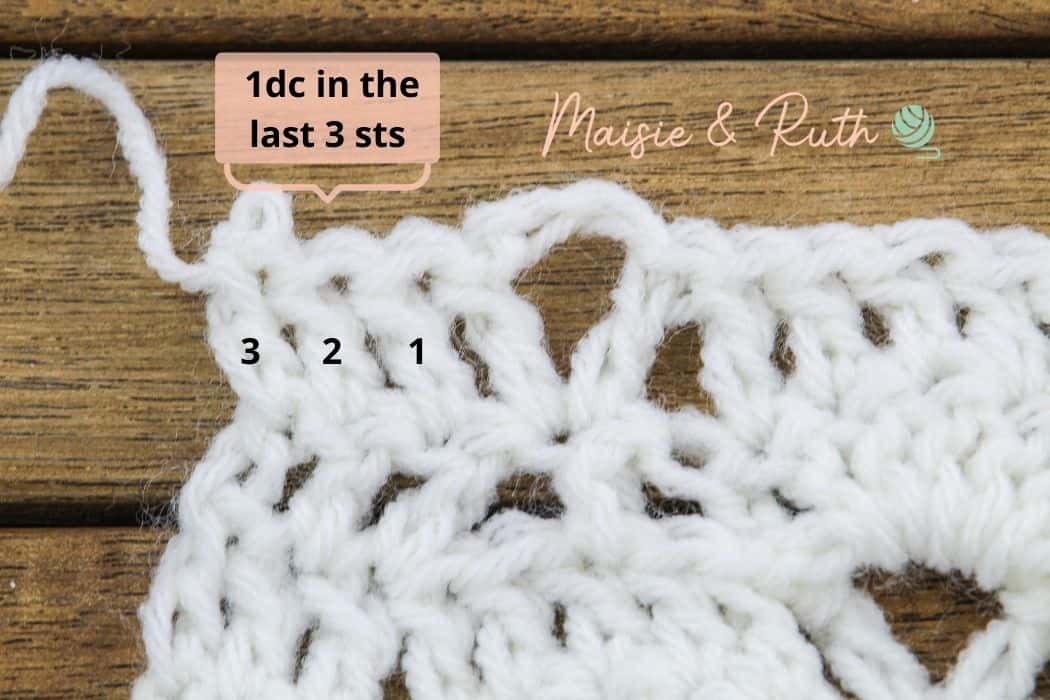
Row 6. Ch2, 1dc in next 2 sts, (1dc, ch3, 1dc) in next st, *sk 1 st, 1dc in next 5 sts, sk 1 st, (1dc, ch3, 1dc) in next st*, repeat from * to * across the row to last 3 sts, 1dc in last 3 sts, TURN, [99 sts total (14 V sts visible)].
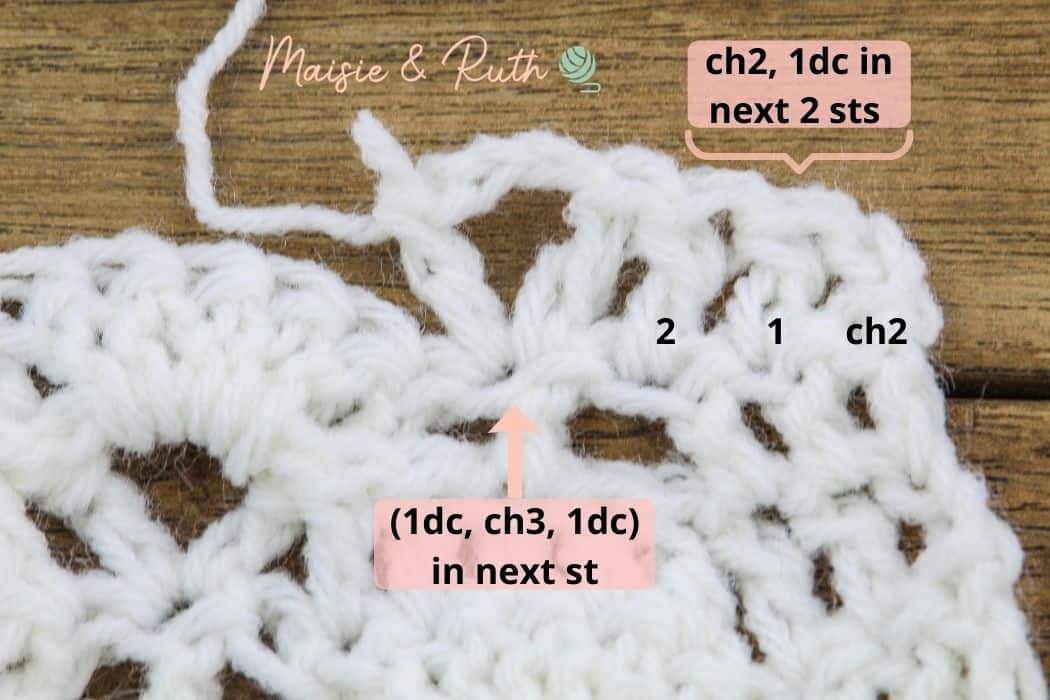
The following stitches that you will now work will form the row repeat:
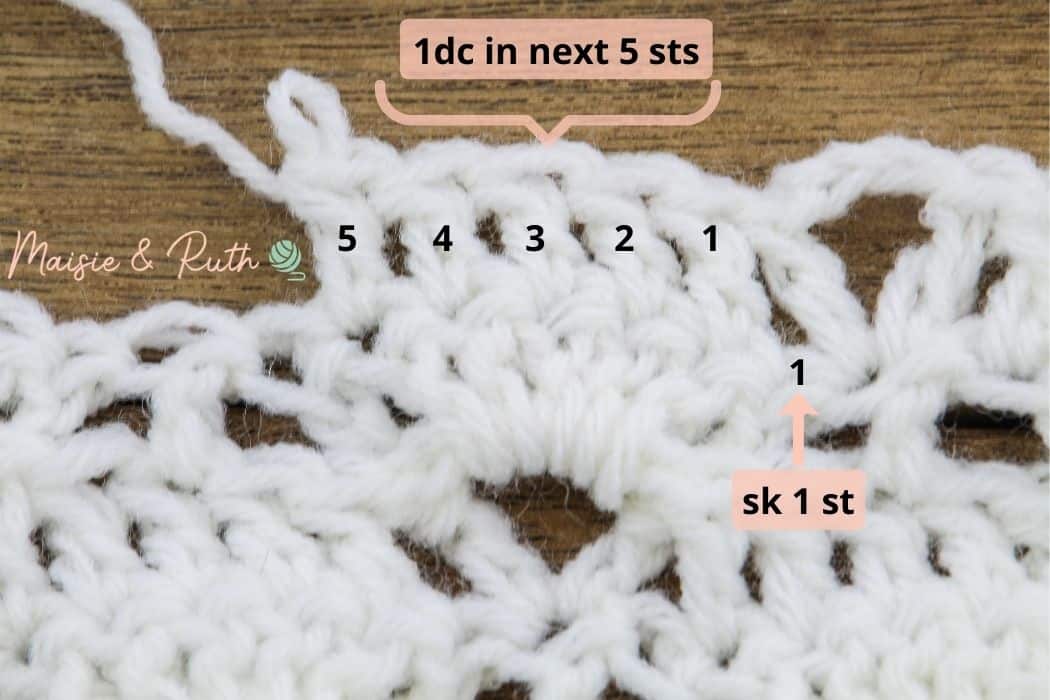
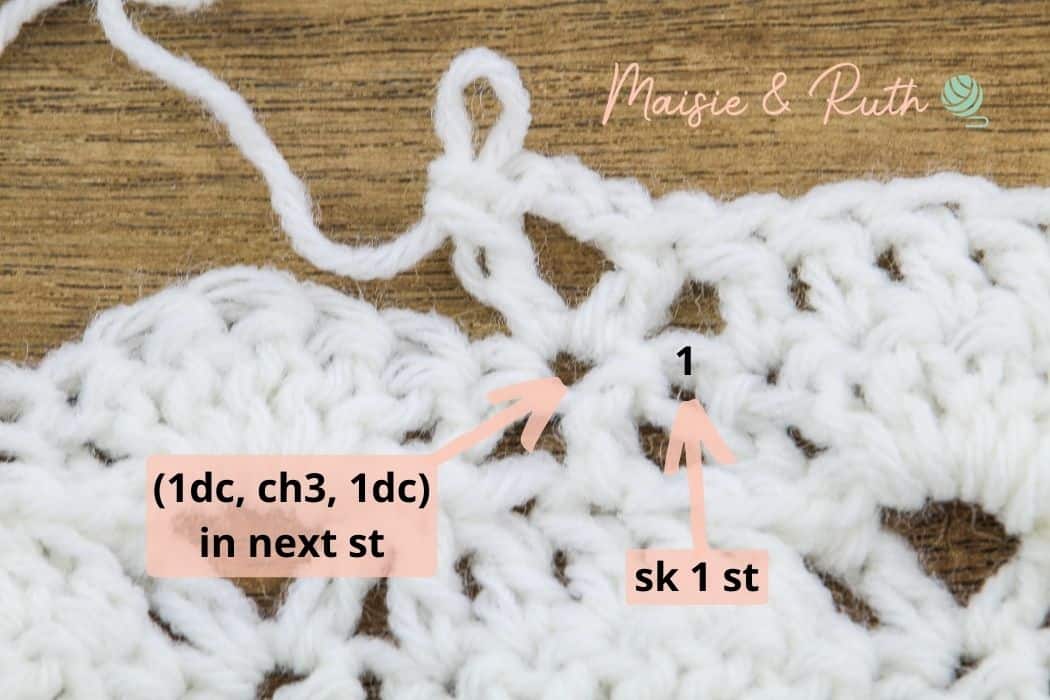
Work the row repeat across the row to the last 3 sts.
Work the last 3 stitches as follows:
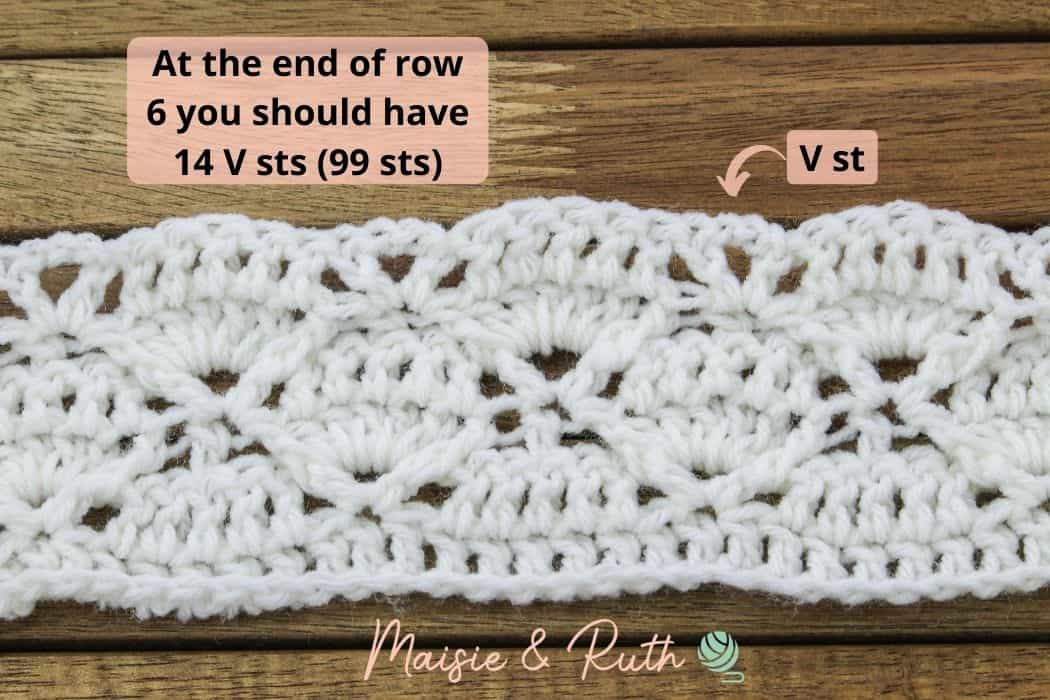
Row 7. Ch2, 1dc in next 2 sts, FPdc in next st, 5dc in ch3 sp, FPdc in next st, *sk 2 sts, 1dc in next st, sk 2 sts, FPdc in next st, 5dc in ch3 sp, FPdc in next st*, repeat from * to * across the row to last 3 sts, 1dc in last 3 sts ,TURN, [117 sts total (14 shells visible)].
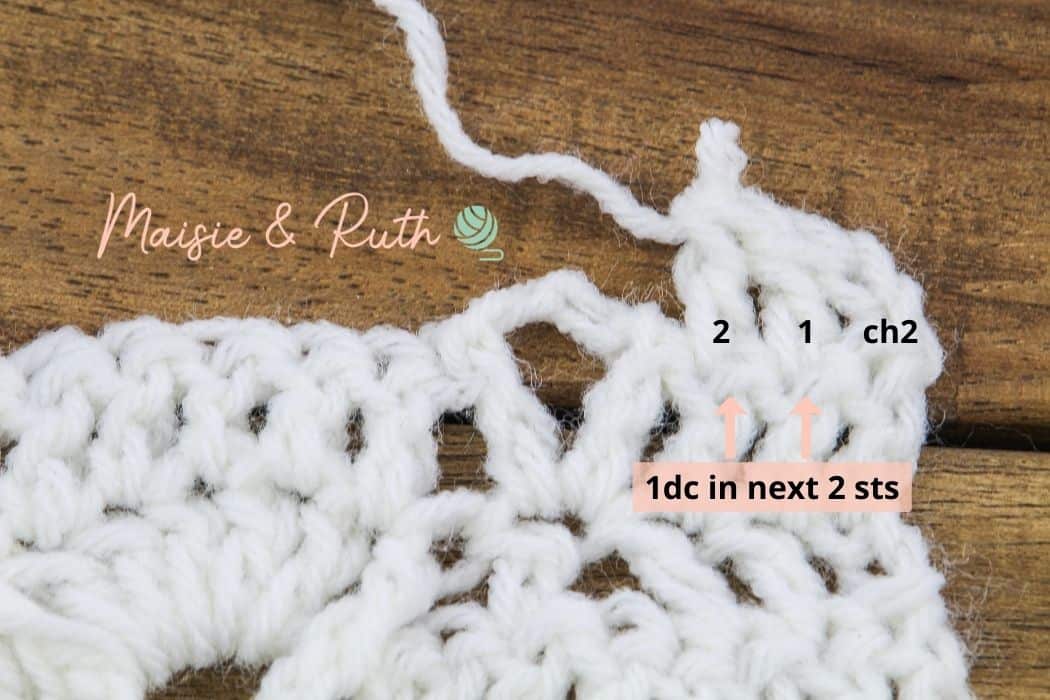
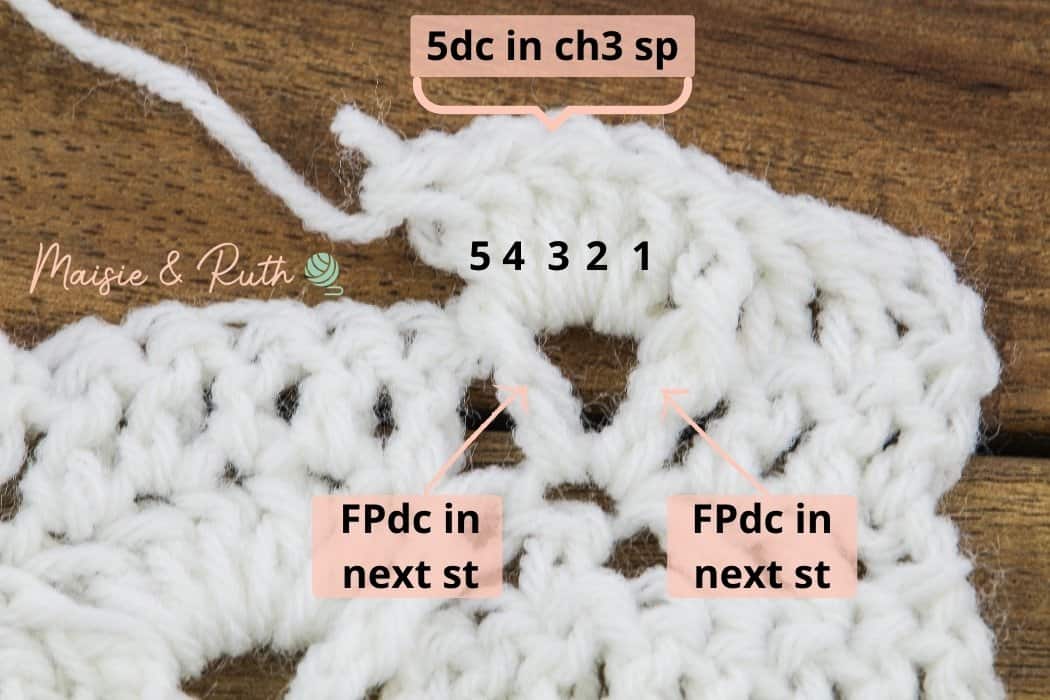
The following stitches that you will now work will form the row repeat:
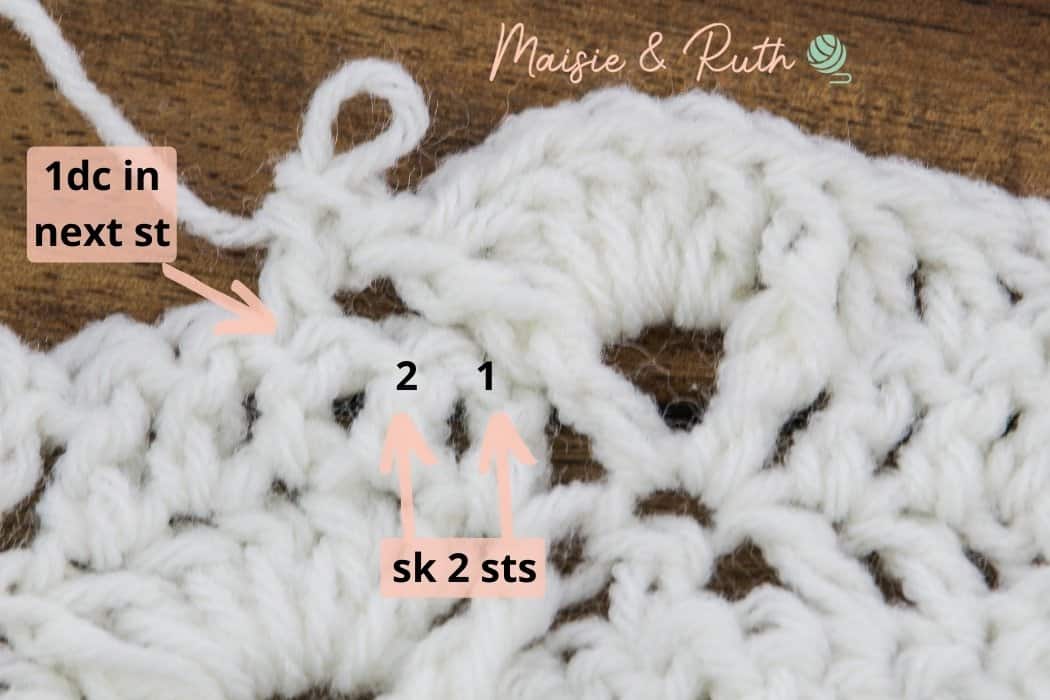
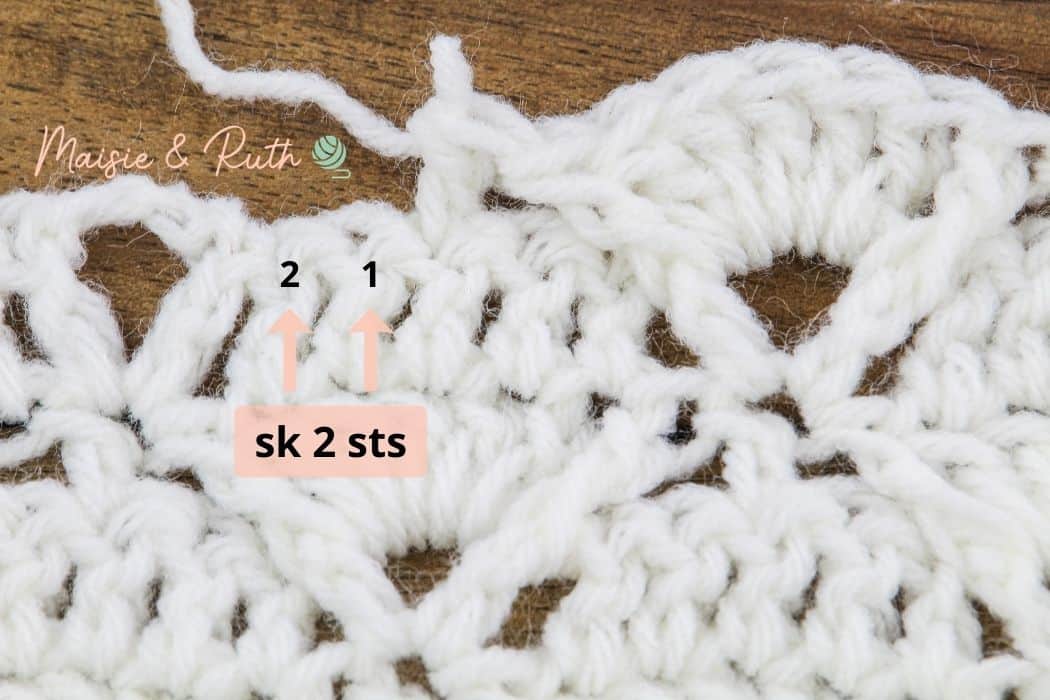
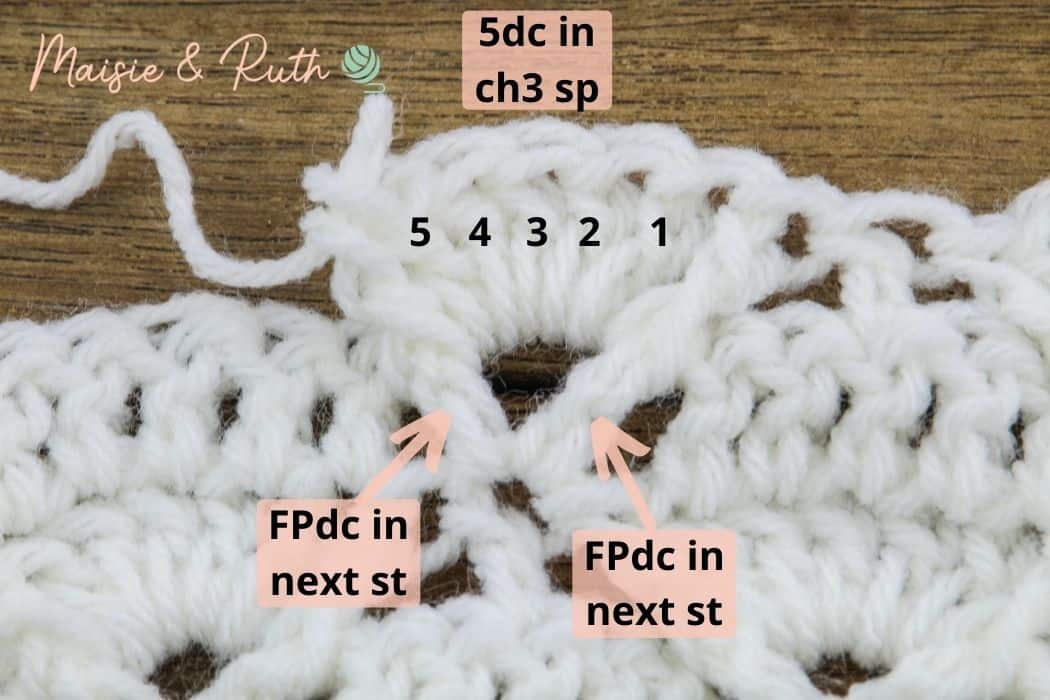
Work the row repeat across the row to the last 3 sts.
Work the last 3 stitches as follows:
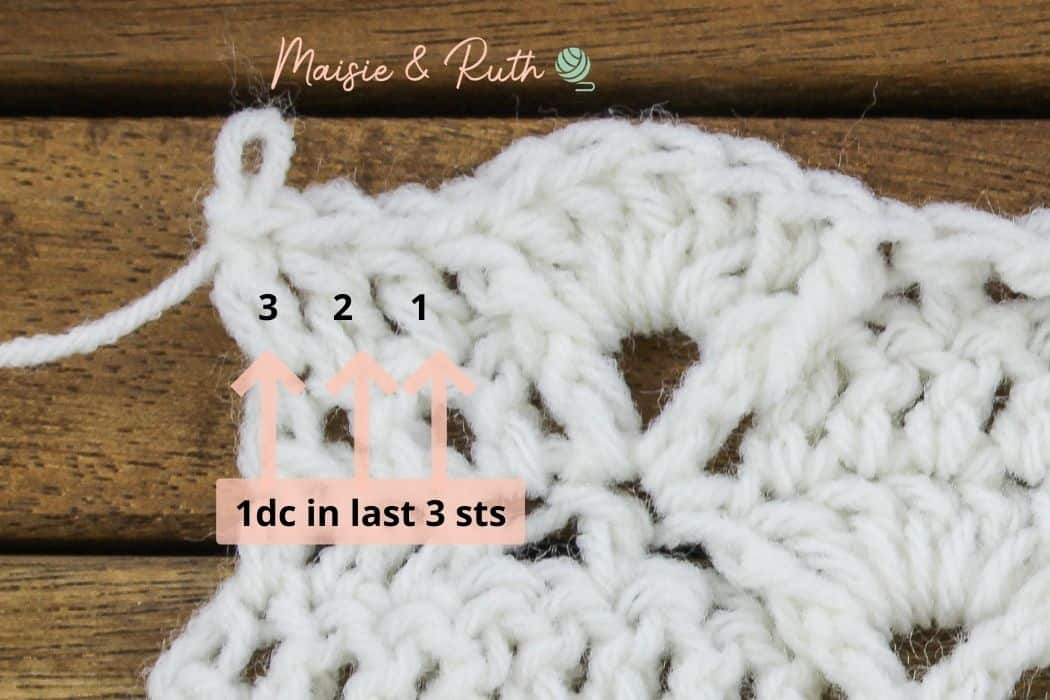
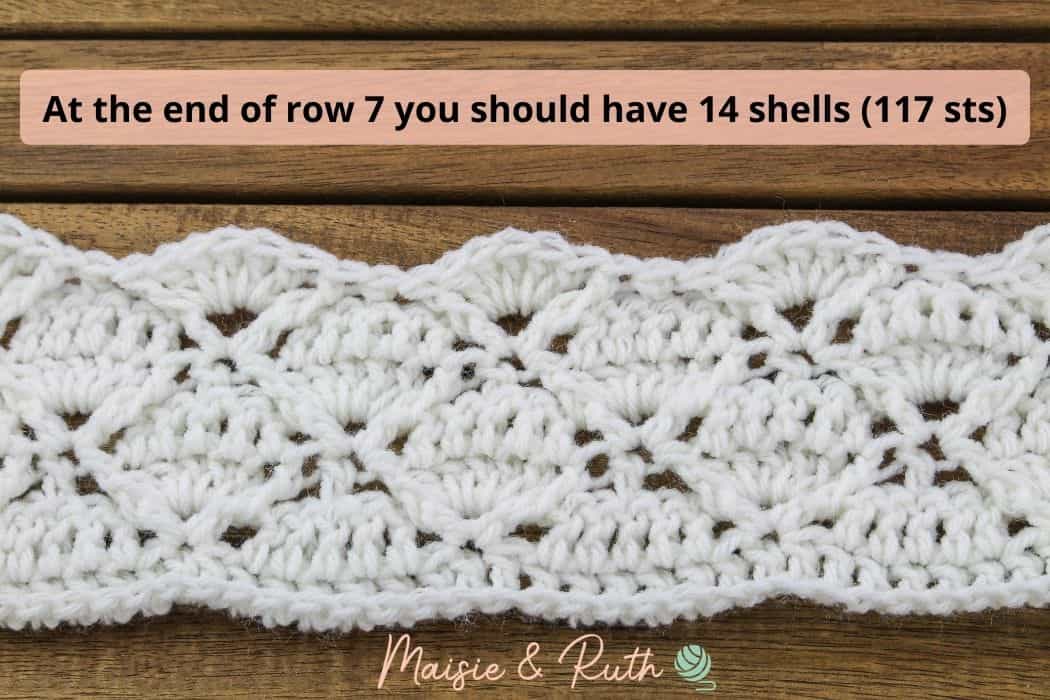
Repeat rows 4 – 7 for fourteen times more, until you have a total of 63 rows.
Make sure that you finish the blanket at the end of a row 7 repeat.
To begin the last row (row 64), cut your yarn and with the right side of the blanket facing you, re-attach it to the top of the chain 2 at the beginning of the row you just worked.
Row 64. Ch2 (counts as your first st), 1dc in next 116 sts [117 sts].
You are now ready to begin working on the border.
Border for Your Crochet Baby Blanket
When you have finished your last row, work the border as follows:
Round 1:
SIDE 1. 2sc in the corner of the blanket, then work 2sc in each dc row end down the side of the blanket, 2sc in the corner st (see photo below).
The image below shows you where you should work 2sc in each dc row end. Take care to work your sc sts around the st (do not try and wriggle your hook into the st).
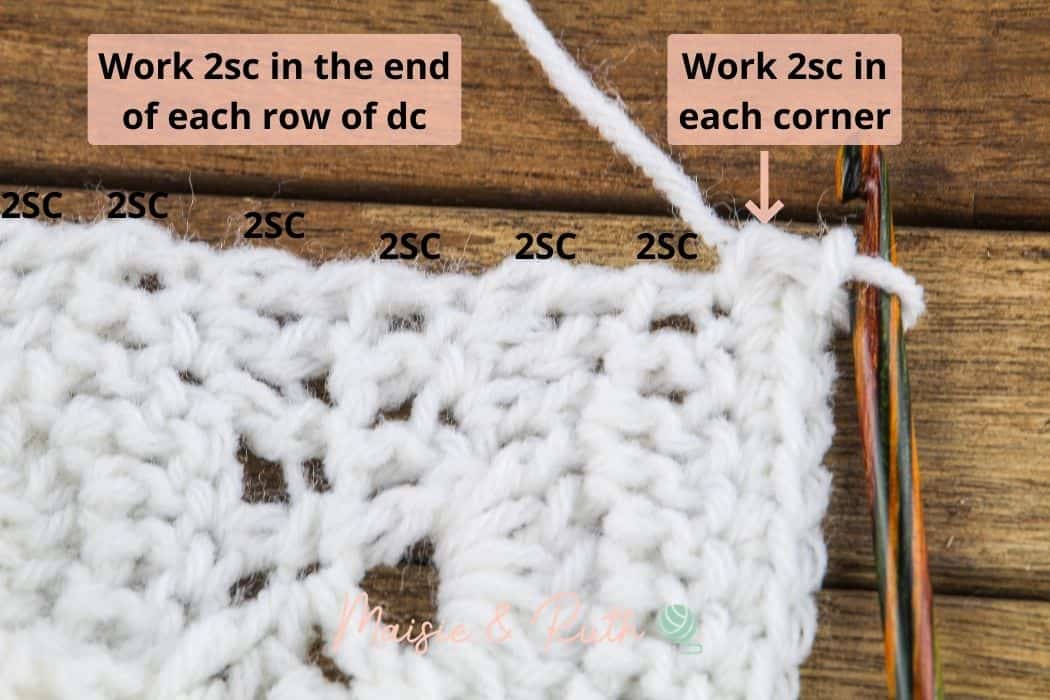
SIDE 2 (Bottom of blanket). 1sc in each st along the bottom foundation row, 2sc in the corner st.
SIDE 3. 2sc in each dc row end up the side of the blanket, 2sc in the corner st
SIDE 4 (Top of blanket). 1sc in each st along the top. Sl st to 1st sc to join. DO NOT TURN.
Round 2. Ch5 (counts as 1dc and a ch3), *sk 1 st, 1dc in next st, ch3*, repeat from * to * around all 4 sides of blanket, sl st to 3rd ch of beg ch5 to join, DO NOT TURN.
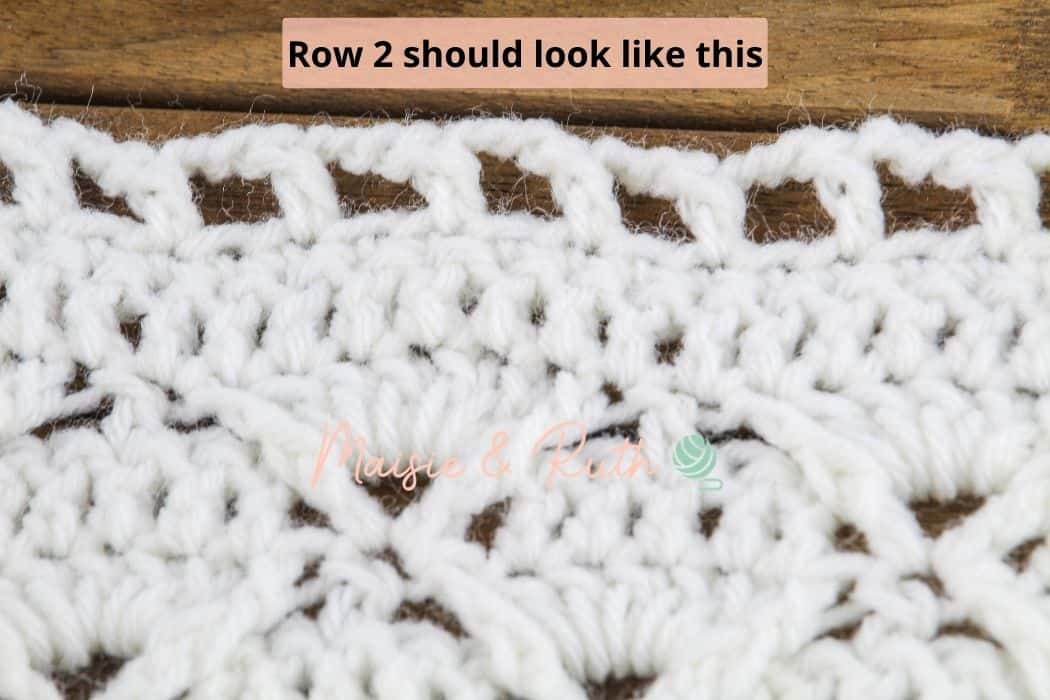
Round 3. *FPdc, 5dc in ch3 sp*, repeat from * to * around all 4 sides of blanket, sl st to 1st FPdc to join, DO NOT TURN.
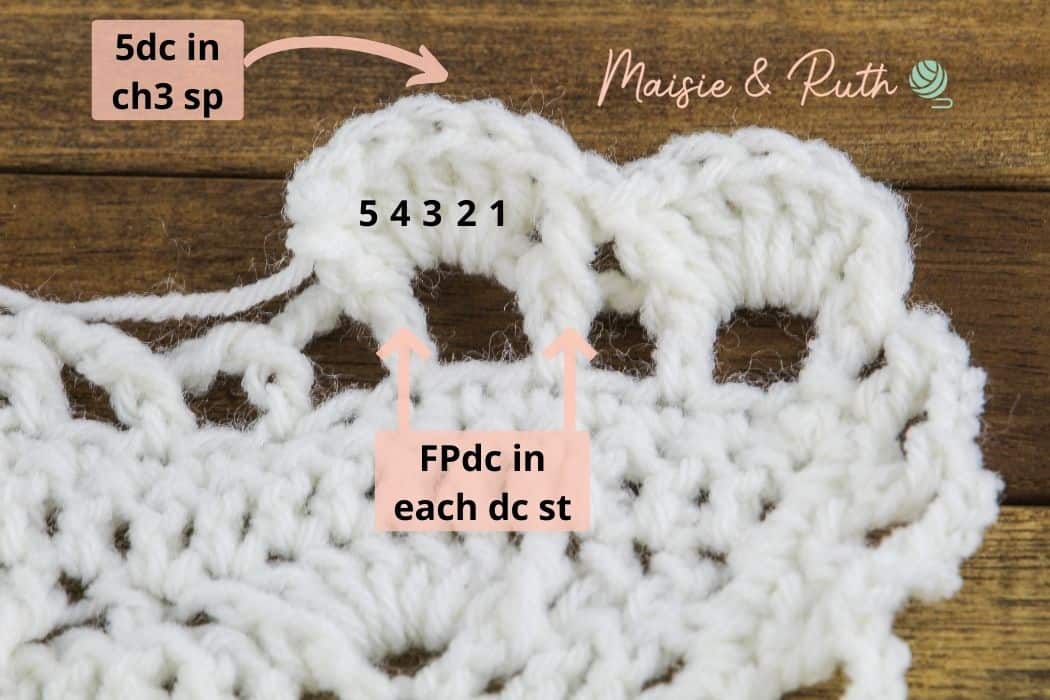
Round 4. Ch1 (does not count as a st), 1sc in each st around all 4 sides of blanket, sl st to 1st sc to join. Cut yarn & fasten off.
OPTIONAL: Weave a ribbon through row 2 in the color of your choice. This step is completely optional… the blanket looks pretty with and without a ribbon!
- 🧶 Watch the full video tutorial – Follow along step by step on YouTube.
- 💛 Join the Maisie and Ruth Facebook Community – Share your finished projects, chat with fellow crocheters, and be inspired.
- 🛍️ Shop printable PDF patterns – Browse the complete collection of ad-free PDF patterns on Etsy.
- 📺 Join YouTube Membership – Get early access to new patterns and exclusive perks.
Pin Me for Later!
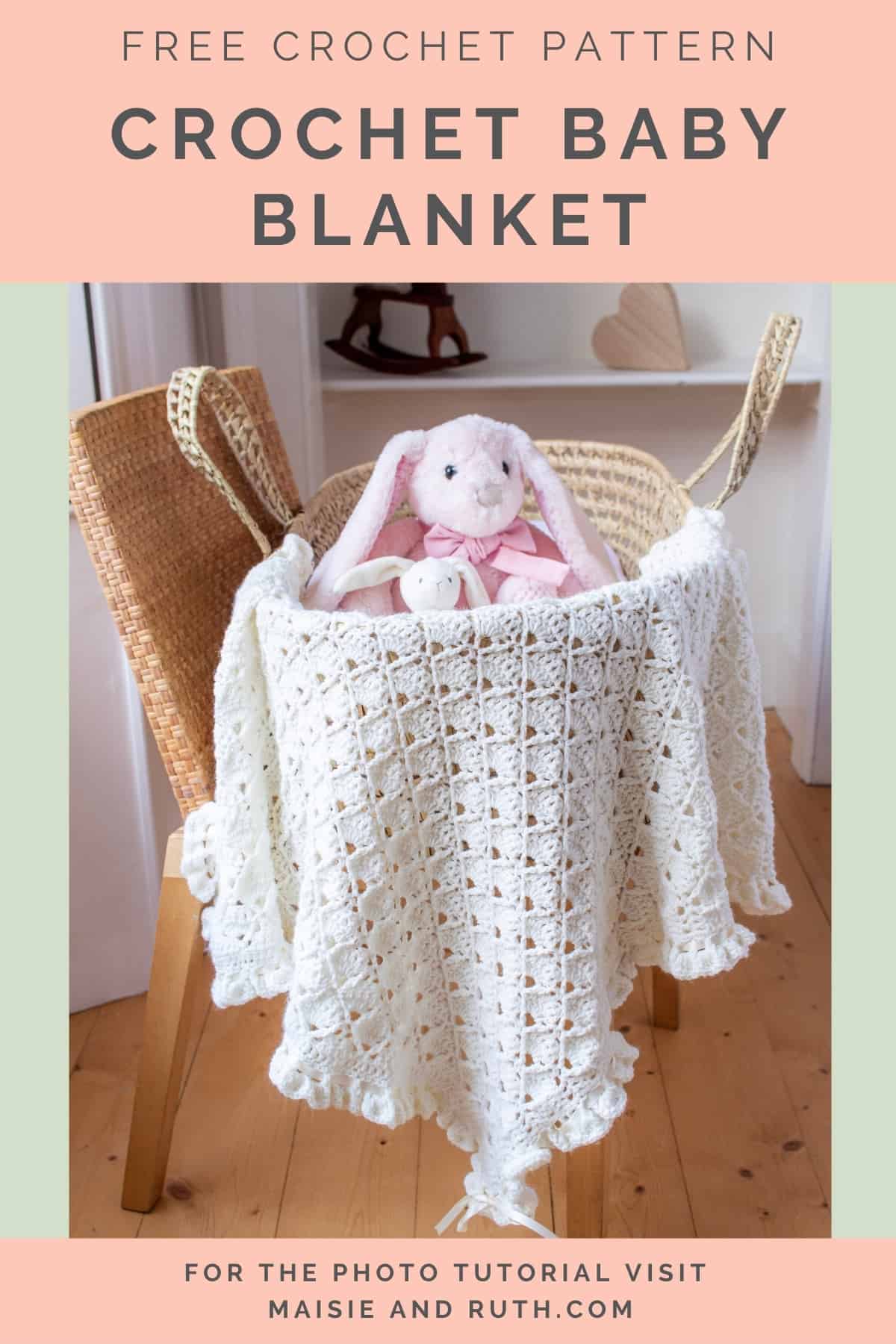
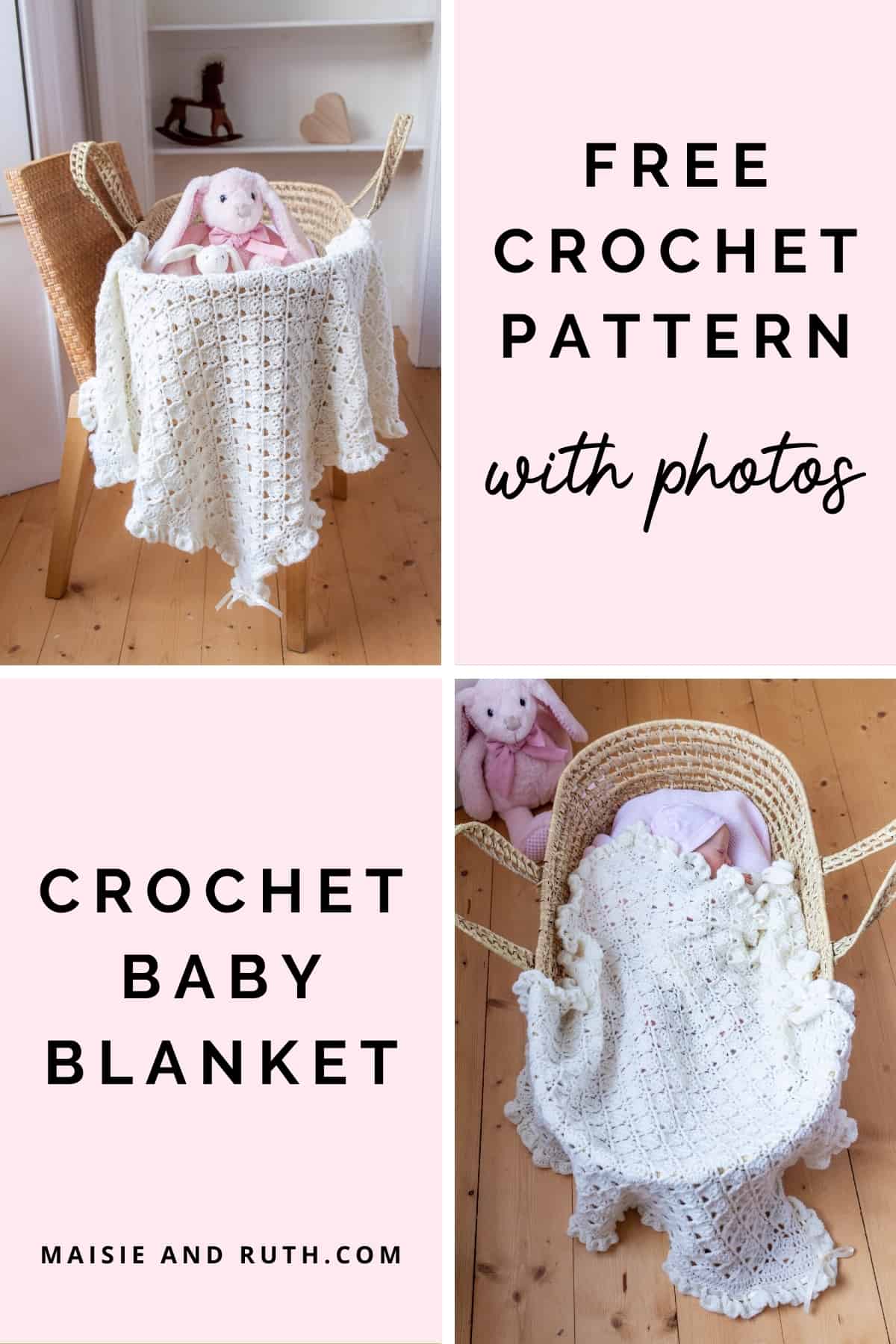
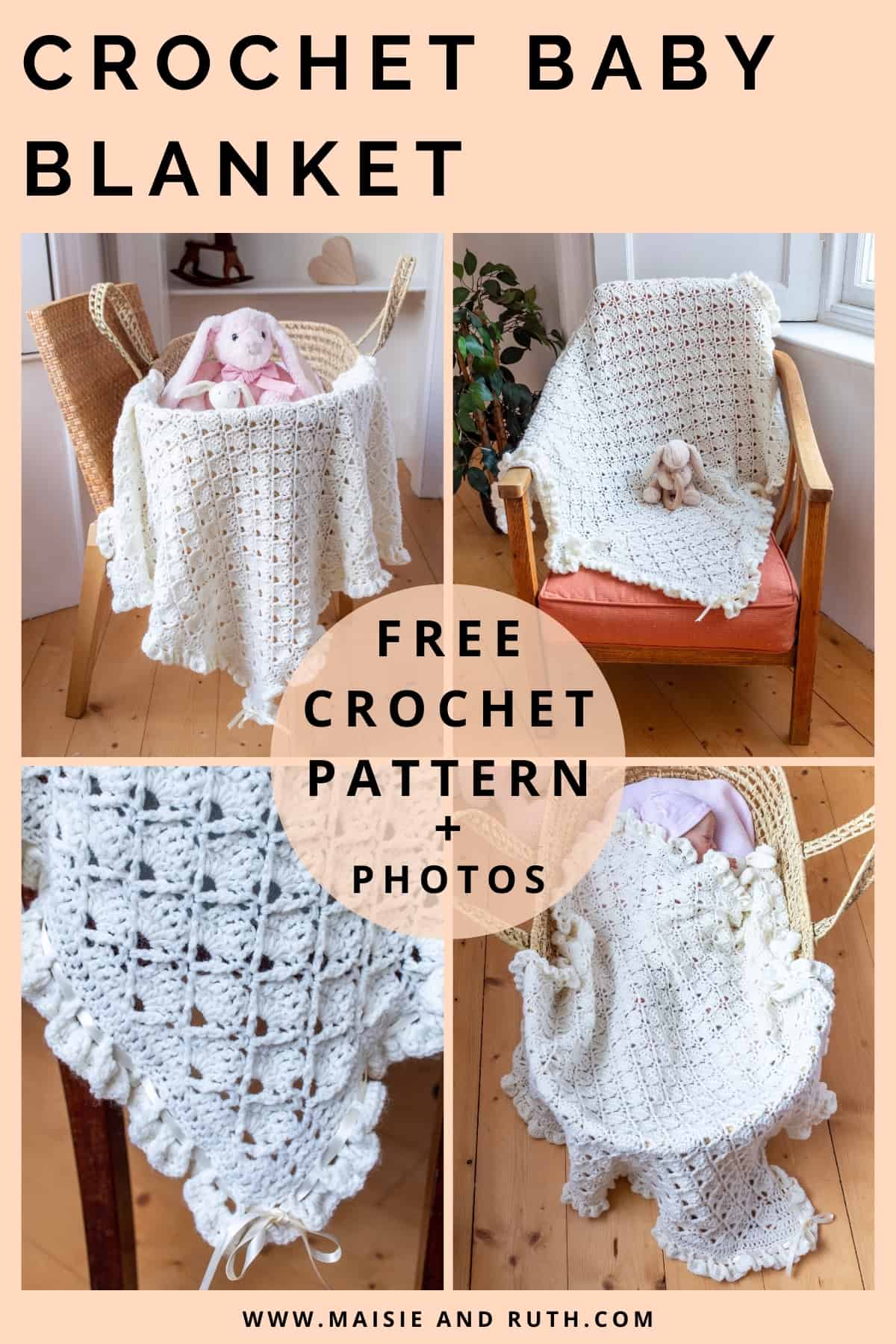
SHARE YOUR FINISHED PROJECT!
I really hope you enjoyed making this pattern! I’d absolutely LOVE to see your finished project.
Join the free Maisie and Ruth Community to share your photos, celebrate your finished makes and connect with fellow crocheters from around the world.
Prefer Facebook? We’d love to see your project in our friendly Maisie and Ruth Facebook Group too!
You can also tag me on Instagram using @maisieandruth and #maisieandruth so I can see your beautiful creations.
And don’t forget to pin this pattern for later or share it with a crochet-loving friend.
Frequently Asked Questions
What stitch is used in the Bonnie Blanket?
The blanket uses the crochet diamond trellis stitch. Double crochet, front post double crochet, V-stitches and shells work together to create the raised design.
Is this an easy crochet baby blanket pattern?
The Bonnie Blanket is an intermediate pattern. It involves more detailed stitch placement than a basic blanket, but the four-row repeat, photo tutorial and accompanying video help guide you through the process.
If you’re ready to move beyond basic stitches, try the practice swatch first to see how you get on.
Can I make the blanket bigger?
Yes! Increase the starting chain in multiples of eight + 5 (then add 2 extra chains for the foundation chain) and work additional complete four-row repeats for extra length. Follow the instructions for finishing the main body before adding the border and remember that you’ll need extra yarn.
Can I use a different yarn weight?
You can experiment with another yarn weight and a suitable hook, but this will change the blanket’s size, texture and drape.
Make a swatch first so you can decide whether you like the fabric and calculate a suitable starting chain. The yarn quantities given in the pattern apply to the original DK version.
Do I need to block my blanket?
Blocking is a helpful finishing step for this design. It can even out the edges and make the stitch pattern more defined. Follow the care guidance for your chosen yarn and use a suitable blocking method.
Is there a video tutorial?
Yes! A video tutorial accompanies the written pattern, so you can follow along and see how the stitches are worked.
Can I print the pattern?
An ad-free, printable PDF is available in my Etsy and Fourthwall shops if you’d like a copy to keep. You can also follow the free version here on the blog.
Copyright
- Copyright © 2021 by Maisie and Ruth Limited. All rights reserved. This crochet baby blanket pattern for the Bonnie Blanket is for personal viewing only. You may view it for free on this blog, but it is protected under applicable copyrights, trademarks, and other proprietary (including but not limited to intellectual property) rights.
- You may not copy, redistribute, or sell this pattern in any form, including digital, printed or photographic formats without permission. Sharing this pattern (in whole or in part) on social media, websites, or messaging platforms is strictly prohibited. This is a theft of the author’s intellectual property, which may result in civil or criminal penalties.
- Thank you for respecting my work and for your continued support — it truly means a lot!



This is beautiful. I would love to make one. Thank you for the pictures; considered to do add a graph? So much easier (for some of us) to follow, save & print to do sometime.
Thanks Cor – I’m glad you like it! I don’t have much experience with the software for creating charts and diagrams but I’ll look into this for you.